Love this? Save it for later!
Share the inspiration with your friends
I used to think Pan de Muerto was more about symbolism than flavor. For years, I’d walk past the bakery displays around Día de Muertos, admire the beautiful bone-shaped decorations on top, and think, “That’s nice. Very pretty. Probably dry.” I’d grab a concha instead and move on with my life. Then last October, my friend Rosa practically shoved a piece across her kitchen counter at me. “Just try it,” she said. “But this one’s different. I made it.” I took a bite of her version, and honestly? I had to sit down. The bread was pillowy soft, fragrant with orange blossom and warm spices, and it had this delicate sweetness that didn’t hit you over the head. I asked for the recipe right there, napkin still in hand.
Here’s the thing about Pan de Muerto that I didn’t understand until that moment: when it’s made right, it’s not just a pretty bread for an altar. It’s genuinely, deeply comforting. It’s the kind of bread you want with coffee on a chilly morning, or torn apart at the end of a long day when you need something that feels like a hug. The orange blossom glaze takes it over the top—it adds this floral, honeyed finish that makes the whole kitchen smell like a garden in bloom. I’ve been making it every fall since, and I’ve tweaked it just enough to make sure it comes out soft every single time. No dry bread here, I promise.
This version became my go-to because it walks that perfect line between traditional and approachable. You don’t need to be a pastry chef to pull it off, and the dough is forgiving enough for a weeknight bake if you plan ahead a little. Maybe you’ve never tried making Pan de Muerto because it felt intimidating. I get that. I was there. But let me tell you—once you smell this bread baking in your own oven, with that orange blossom scent filling every corner of your kitchen, you’ll understand why I keep making it year after year.
Why You’ll Love This Recipe
This Cozy Pan de Muerto with Orange Blossom Glaze isn’t just another bread recipe. It’s the result of multiple test batches, a few happy accidents, and one very memorable evening where I forgot the yeast and learned a hard lesson. I’ve tested this version with home bakers of all skill levels, and it consistently gets the same reaction: wide eyes and a request for the recipe before the plate is empty.
- Incredibly Soft Texture : The secret is a tangzhong-style starter (a cooked flour and milk paste) that keeps the bread moist for days. No stale, dry crumb here.
- Simple, Meaningful Ingredients : You probably already have flour, sugar, butter, and eggs. The orange blossom water and zest are the only special additions, and they’re worth tracking down.
- Perfect for Día de Muertos or Cozy Fall Baking : This bread belongs on an ofrenda, yes, but it also belongs on your breakfast table with a smear of butter and a cup of café de olla.
- Crowd-Pleaser Across Generations : Kids love the sweet glaze, and adults appreciate the sophisticated floral notes. It disappears fast at gatherings.
- Stress-Free Dough Handling : The dough is soft but not sticky, easy to shape, and forgiving if you need to walk away for an extra hour during the rise.
What makes this recipe different is the combination of the tangzhong method and the orange blossom glaze. The tangzhong locks in moisture so the bread stays tender even on day three. The glaze adds that unmistakable floral sweetness that makes Pan de Muerto special—it’s not just a sugar glaze, it’s a fragrant finish that feels celebratory. I’ve also adjusted the sugar level so the bread itself is mildly sweet, letting the glaze do the heavy lifting. It’s comfort food reimagined: traditional techniques with a few modern tricks to guarantee success.
What Ingredients You Will Need
This recipe uses simple, wholesome ingredients to create a bread that’s both aromatic and tender. Most are pantry staples, with a couple of specialty items that make all the difference.
For the Tangzhong (Starter Paste)
- 3 tablespoons bread flour
- 1/2 cup whole milk (adds richness; 2% works too)
For the Dough
- 2 1/2 cups bread flour (I prefer King Arthur for consistent protein content)
- 1/4 cup granulated sugar
- 1 teaspoon salt
- 2 1/4 teaspoons active dry yeast (one packet)
- 1/2 cup whole milk, warm (about 110°F)
- 2 large eggs, room temperature
- 1 teaspoon orange blossom water (look for it in the international aisle or a Middle Eastern market)
- 1 tablespoon orange zest (from one large orange)
- 4 tablespoons unsalted butter, softened (cut into small pieces)
For the Orange Blossom Glaze
- 1 cup powdered sugar, sifted
- 2 tablespoons orange blossom water
- 1 tablespoon fresh orange juice (adds brightness)
- Pinch of salt
For the Topping
- 2 tablespoons unsalted butter, melted
- 2 tablespoons granulated sugar mixed with 1 teaspoon orange zest (orange sugar)
A few ingredient notes: The bread flour really matters here. It has more protein than all-purpose, which gives the dough structure while staying tender. If you only have all-purpose, reduce the milk by 1 tablespoon to compensate for the lower protein. The orange blossom water is non-negotiable for that authentic floral aroma—vanilla extract is not a substitute, though you could use rose water in a pinch for a different floral note. I buy my orange blossom water from a local Middle Eastern grocer, but it’s also available online.
For the butter, make sure it’s truly softened—leave it out for an hour, not microwaved. Cold butter won’t incorporate properly and will make the dough dense. The eggs should also be at room temperature; if you forget, place them in a bowl of warm water for 5 minutes before using.
Equipment Needed
You don’t need a fancy bakery setup for this bread. Here’s what you’ll actually use:
- Stand mixer with dough hook : This dough comes together beautifully in a mixer, and it saves your arms from kneading. A handheld mixer with dough hooks works too, but it’ll take longer.
- Digital kitchen scale : I know, I know—another gadget. But measuring flour by weight (350g for the dough flour) gives consistent results every time. If you’re using cups, spoon and level carefully.
- Large mixing bowl : For the tangzhong and for proofing the dough.
- Small saucepan : To make the tangzhong paste.
- Baking sheet : Line it with parchment paper for easy cleanup.
- Pastry brush : For applying the melted butter before baking.
- Cooling rack : Essential for letting the glaze set without making the bread soggy.
- Microplane or fine grater : For zesting the orange. A box grater works but gives chunkier zest.
If you don’t have a stand mixer, you can knead by hand. It’ll take about 12-15 minutes of steady work, and the dough will feel slightly sticky at first—resist the urge to add too much extra flour. A bench scraper helps manage sticky dough on the counter.
Preparation Method
- Make the tangzhong (10 minutes) : In a small saucepan, whisk together the 3 tablespoons bread flour and 1/2 cup whole milk until smooth. Cook over medium heat, stirring constantly, until the mixture thickens into a paste—about 2-3 minutes. It should look like thick pudding. Remove from heat and let it cool to room temperature while you prep the other ingredients.
- Activate the yeast (5 minutes) : In the bowl of your stand mixer, combine the warm milk (110°F) and 1 tablespoon of the sugar. Sprinkle the yeast on top and let it sit for 5 minutes until foamy. If it doesn’t foam, your milk was too hot or the yeast is dead—start over with fresh yeast.
- Mix the dough (10 minutes) : Add the remaining sugar, salt, eggs, orange blossom water, orange zest, and the cooled tangzhong to the yeast mixture. Add the 2 1/2 cups bread flour. Mix on low with the dough hook until a shaggy dough forms, about 2 minutes. Increase to medium speed and knead for 5 minutes. The dough should be smooth and slightly tacky but not sticky.
- Add the butter (5 minutes) : With the mixer running on medium, add the softened butter pieces one at a time, waiting until each is incorporated before adding the next. This takes patience—about 3-4 minutes total. The dough will look messy at first, then come together into a silky, elastic ball. Knead for another 2 minutes after the last butter piece is added.
- First rise (1 1/2 to 2 hours) : Transfer the dough to a lightly oiled bowl, cover with plastic wrap or a damp kitchen towel, and let it rise in a warm spot until doubled in size. I set my oven to “proof” setting or just leave it on the counter near a sunny window. If your kitchen is cold, it might take 2 1/2 hours—be patient.
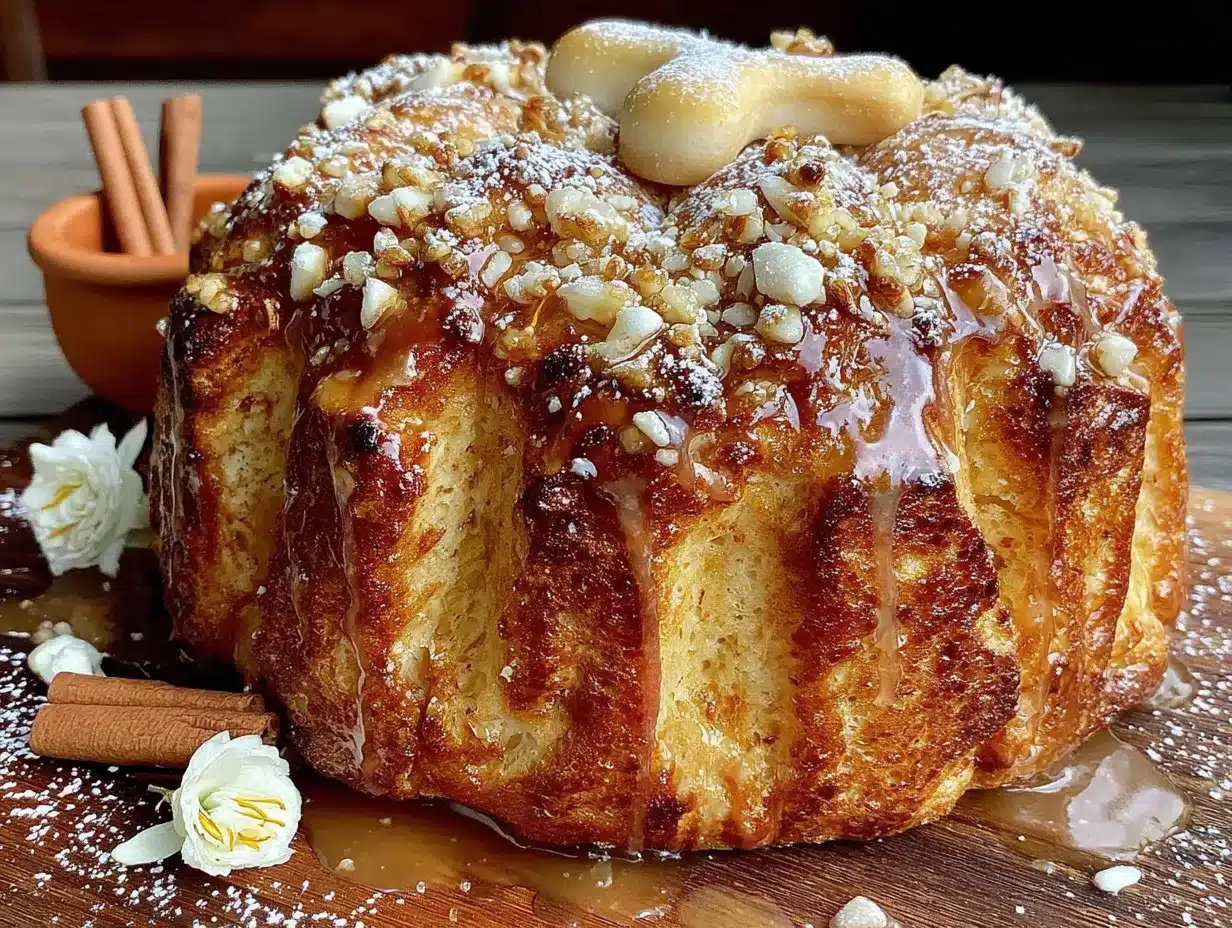
- Shape the dough (15 minutes) : Punch down the dough and turn it out onto a lightly floured surface. Divide it into two pieces: one large piece (about 2/3 of the dough) for the base, and one smaller piece (1/3) for the bone decorations. Shape the large piece into a smooth round ball and place it on your parchment-lined baking sheet. Divide the smaller piece into 4 equal parts for the “bones” and one tiny piece for the top “skull” knob. Roll each bone piece into a 6-inch rope, then flatten slightly. Arrange them in a cross pattern on top of the dough ball—two ropes crossing over the center, and two more forming a ring around the edge. Place the small knob in the center where they cross.
- Second rise (45 minutes to 1 hour) : Cover the shaped dough loosely with plastic wrap and let it rise until puffy and almost doubled. It should look soft and pillowy when you gently poke it.
- Bake (25-30 minutes) : Preheat your oven to 350°F. Brush the risen dough with the melted butter (this helps it brown beautifully). Bake for 25-30 minutes, rotating the pan halfway through. The bread should be deep golden brown and sound hollow when tapped on the bottom. If the top is browning too fast, tent loosely with foil after 15 minutes.
- Cool completely (1 hour) : Transfer the bread to a cooling rack and let it cool completely—this is crucial. Warm bread will melt the glaze into a sticky mess.
- Glaze and finish (10 minutes) : Whisk together the powdered sugar, orange blossom water, orange juice, and salt until smooth. The glaze should be thick but pourable—add more orange juice a teaspoon at a time if needed. Drizzle generously over the cooled bread, letting it drip down the sides. Sprinkle the orange sugar on top immediately while the glaze is still wet. Let the glaze set for 15-20 minutes before slicing.
Cooking Tips & Techniques
Here’s the thing about yeasted breads: they’re living things. They respond to temperature, humidity, and your mood. I’ve had days where the dough doubled in 45 minutes and days where it took three hours. Both loaves turned out fine. Trust the process, not the clock.
Don’t skip the tangzhong. I know it’s an extra step, but it’s the reason this bread stays soft for days. The cooked flour paste gelatinizes the starches, which traps moisture in a way that simple kneading can’t achieve. I learned this trick from Japanese milk bread recipes, and it works beautifully for Pan de Muerto.
Temperature matters more than you think. If your milk is over 120°F, it’ll kill the yeast. If it’s under 100°F, the yeast will be sluggish. Use a thermometer if you have one—I ruined three batches before I bought a $10 instant-read thermometer. Best investment I’ve made in my baking.
Wet hands are your friend. When shaping the dough, lightly wet your hands instead of flouring them. This prevents sticking without adding extra flour that could dry out the dough. I learned this from a baker in Oaxaca who shaped hundreds of these loaves daily.
One mistake I made: I once forgot to add the salt. The dough rose like crazy and then collapsed in the oven. Salt isn’t just for flavor—it controls yeast activity and strengthens the gluten structure. Don’t skip it.
Multitasking tip: Make the tangzhong and activate the yeast while you’re waiting for your butter to soften. That way, everything comes together at the same time and you’re not rushing.
Variations & Adaptations
This recipe is surprisingly flexible. Here are some ways I’ve adapted it over the years:
Dairy-Free Version: Swap the whole milk for oat milk or almond milk (oat milk gives the best texture), and use vegan butter in the same amounts. The tangzhong works fine with plant-based milk—I’ve tested it with oat milk and it was almost indistinguishable from the original.
Citrus Swap: If you can’t find orange blossom water, use lemon zest and a lemon glaze instead. It’s not traditional, but it’s bright and delicious. I made this version for a friend who’s allergic to oranges, and she asked for the recipe twice.
Spiced Version: Add 1 teaspoon of ground cinnamon and 1/2 teaspoon of ground anise to the dry ingredients. This gives the bread a warm, winter-spice flavor that pairs beautifully with the orange glaze. I do this version around Christmas and it’s always a hit.
Gluten-Free Adaptation: I haven’t perfected this yet, but a reader told me she used a 1:1 gluten-free flour blend and added 1 teaspoon of xanthan gum. She said the texture was denser but still delicious. If you try this, let me know how it goes in the comments.
Less Sweet Version: Reduce the sugar in the dough to 2 tablespoons and skip the glaze entirely. Brush the baked bread with melted butter and sprinkle with a little cinnamon sugar instead. This is how Rosa’s grandmother made it, and it’s lovely with coffee.
Serving & Storage Suggestions
This bread is best served the day it’s made, when the glaze is still slightly crisp and the crumb is pillowy soft. Slice it thick—about 1-inch slices—and serve it at room temperature with a cup of Mexican hot chocolate or café de olla. The floral notes of the orange blossom really shine when paired with a warm, spiced drink.
For a more indulgent treat, toast a slice lightly and spread it with salted butter. The contrast between the sweet glaze and the salty butter is addictive. I’ve also served it alongside a simple fruit salad for brunch, and it disappears every time.
Storage: Keep the bread in an airtight container at room temperature for up to 3 days. Do not refrigerate—it will dry out the crumb. If you need to store it longer, wrap it tightly in plastic wrap and freeze for up to 2 months. Thaw at room temperature, then reheat in a 300°F oven for 5 minutes to revive the texture.
Reheating: The microwave will make the bread rubbery. Instead, wrap slices in foil and warm them in a 325°F oven for 8-10 minutes. The glaze will soften and the bread will taste freshly baked.
The flavors actually develop overnight. On day two, the orange blossom aroma is more pronounced and the crumb has settled into a tender, almost brioche-like texture. I actually prefer it on day two for that reason—but good luck having any left by then.
Nutritional Information & Benefits
This is a treat, not a health food, but here’s what you should know. One slice (1/12 of the loaf) contains approximately:
- Calories: 280
- Fat: 10g
- Carbohydrates: 42g
- Protein: 6g
- Fiber: 1g
- Sugar: 18g
The orange zest and orange blossom water add a touch of vitamin C and antioxidants, but honestly, the real benefit here is the comfort factor. Baking this bread is a meditative process—the kneading, the waiting, the smell filling your kitchen. There’s a reason bread-baking has become a form of therapy for so many people.
For those with dietary restrictions: this recipe contains gluten, dairy, and eggs. I’ve included dairy-free and gluten-free notes in the variations section above. The orange blossom glaze is naturally vegan if you use a plant-based milk in the dough.
I believe in enjoying food that nourishes both body and soul. This bread does the latter beautifully. One slice with your morning coffee, shared with someone you love, is a small ritual worth keeping.
Conclusion
This Cozy Pan de Muerto with Orange Blossom Glaze is more than a recipe—it’s an invitation to slow down and bake something meaningful. The tangzhong method guarantees a soft, tender crumb that stays fresh for days. The orange blossom glaze adds a floral sweetness that feels special without being fussy. And the process itself—kneading, shaping, watching it rise—is a quiet act of care in a busy world.
I love this recipe because it bridges tradition and practicality. It honors the Día de Muertos roots of Pan de Muerto while making it accessible for any home baker. Whether you’re making it for an ofrenda, a fall gathering, or just because you want your kitchen to smell incredible, this bread delivers.
Now I want to hear from you. Did you try this recipe? Did you add your own twist? Drop a comment below and tell me how it turned out. Share a photo on Pinterest and tag me—I love seeing your bakes. And if you have questions about the dough or the glaze, ask away. I’m here to help you nail this bread on your first try. Happy baking, friends. May your kitchen smell like orange blossoms and your heart feel full.
Frequently Asked Questions
Can I make the dough ahead of time?
Yes! After the first rise, punch down the dough, wrap it tightly in plastic wrap, and refrigerate for up to 24 hours. When you’re ready to bake, let it sit at room temperature for 30 minutes, then shape and proceed with the second rise.
Why did my bread come out dense?
This usually happens for one of three reasons: the dough didn’t rise long enough, the yeast was dead, or too much flour was added during kneading. Use a thermometer for your milk, be patient with the rise, and resist adding extra flour.
Can I use all-purpose flour instead of bread flour?
You can, but the bread will be less chewy and slightly more cake-like. Reduce the milk by 1 tablespoon if you substitute. Bread flour gives the best structure for the decorative bones on top.
My glaze turned out too thin. What went wrong?
You probably added too much liquid. Fix it by whisking in more powdered sugar, 1 tablespoon at a time, until it reaches a thick, pourable consistency. If it’s too thick, add orange juice a drop at a time.
Can I freeze the unbaked shaped dough?
I don’t recommend it. The second rise is crucial for the final texture, and freezing can damage the yeast. Bake the bread first, then freeze the cooled, unglazed loaf for up to 2 months. Glaze after thawing.
Pin This Recipe!
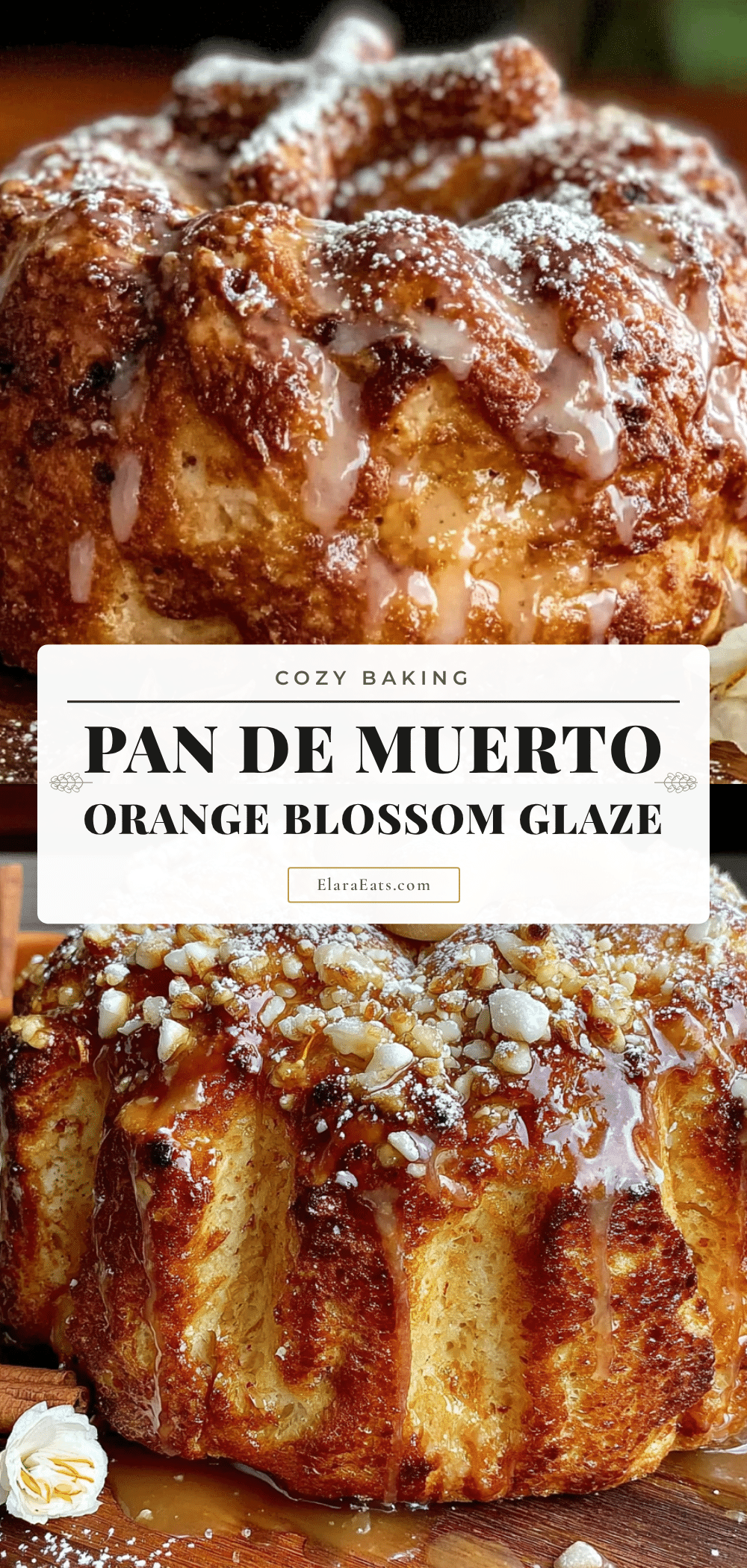
The Best Cozy Pan de Muerto with Orange Blossom Glaze
This pillowy soft Pan de Muerto with a fragrant orange blossom glaze is a comforting, traditional bread perfect for Día de Muertos or cozy fall baking. The tangzhong method ensures a tender crumb that stays fresh for days.
- Prep Time: 30 minutes
- Cook Time: 30 minutes
- Total Time: 3 hours 30 minutes
- Yield: 12 servings 1x
- Category: Bread
- Cuisine: Mexican
Ingredients
- 3 tablespoons bread flour
- 1/2 cup whole milk
- 2 1/2 cups bread flour
- 1/4 cup granulated sugar
- 1 teaspoon salt
- 2 1/4 teaspoons active dry yeast
- 1/2 cup whole milk, warm (about 110°F)
- 2 large eggs, room temperature
- 1 teaspoon orange blossom water
- 1 tablespoon orange zest
- 4 tablespoons unsalted butter, softened
- 1 cup powdered sugar, sifted
- 2 tablespoons orange blossom water
- 1 tablespoon fresh orange juice
- Pinch of salt
- 2 tablespoons unsalted butter, melted
- 2 tablespoons granulated sugar mixed with 1 teaspoon orange zest
Instructions
- Make the tangzhong: In a small saucepan, whisk together 3 tablespoons bread flour and 1/2 cup whole milk until smooth. Cook over medium heat, stirring constantly, until thickened into a paste (about 2-3 minutes). Remove from heat and let cool to room temperature.
- Activate the yeast: In the bowl of a stand mixer, combine warm milk (110°F) and 1 tablespoon of the sugar. Sprinkle yeast on top and let sit for 5 minutes until foamy.
- Mix the dough: Add remaining sugar, salt, eggs, orange blossom water, orange zest, and cooled tangzhong to the yeast mixture. Add 2 1/2 cups bread flour. Mix on low with dough hook until shaggy, then knead on medium for 5 minutes until smooth and tacky.
- Add the butter: With mixer on medium, add softened butter pieces one at a time, waiting until each is incorporated. Knead for another 2 minutes after last piece is added.
- First rise: Transfer dough to a lightly oiled bowl, cover, and let rise in a warm spot until doubled (1 1/2 to 2 hours).
- Shape the dough: Punch down dough and divide into two pieces (2/3 for base, 1/3 for decorations). Shape large piece into a smooth round on a parchment-lined baking sheet. Divide small piece into 4 ropes for ‘bones’ and one small knob. Arrange ropes in a cross pattern on top, place knob in center.
- Second rise: Cover shaped dough loosely and let rise until puffy (45 minutes to 1 hour).
- Bake: Preheat oven to 350°F. Brush risen dough with melted butter. Bake for 25-30 minutes, rotating halfway, until deep golden brown and hollow when tapped.
- Cool completely: Transfer to a cooling rack and let cool completely (about 1 hour).
- Glaze and finish: Whisk together powdered sugar, orange blossom water, orange juice, and salt until smooth. Drizzle over cooled bread and sprinkle with orange sugar immediately. Let set for 15-20 minutes before slicing.
Notes
Don’t skip the tangzhong—it keeps the bread moist for days. Use a thermometer for milk temperature (110°F). Wet hands when shaping to avoid adding extra flour. The bread is best served the day it’s made, but flavors develop overnight. Store in an airtight container at room temperature for up to 3 days; freeze unglazed loaf for up to 2 months.
Nutrition
- Serving Size: 1 slice (1/12 of loa
- Calories: 280
- Sugar: 18
- Sodium: 200
- Fat: 10
- Saturated Fat: 6
- Carbohydrates: 42
- Fiber: 1
- Protein: 6
Keywords: Pan de Muerto, orange blossom, Día de Muertos, Mexican bread, tangzhong, fall baking, holiday bread