Love this? Save it for later!
Share the inspiration with your friends
There used to be a steakhouse in a strip mall off Route 9 in New Jersey called The Smoke and Sizzle that made a prime rib so tender you could cut it with a butter knife. When they closed — suddenly, with a handwritten sign taped to the door — I honestly felt a little lost. That was my go-to place for celebrations, for quiet Tuesday nights when I needed a win, for the year I turned thirty and wanted to feel like a grown-up. After about seven tries — some dry, some bland, one that I accidentally cooked to shoe-leather toughness — I finally got it. This recipe is that exact memory, brought back to life in my own kitchen.
I remember the first time I attempted it. I bought a roast that was way too small, didn’t let it come to room temperature, and ended up with a gray exterior and a raw center. My kitchen smelled like disappointment. But I kept at it, tweaking the herb butter ratio, the roasting temperature, the resting time. The key, I learned, is patience. And butter. Lots of butter.
Maybe you’ve been there — chasing a flavor from a restaurant that no longer exists, or a holiday dinner that your grandmother used to make. This prime rib roast is that dish. It’s the centerpiece of a meal that makes everyone stop talking when they take the first bite. The herb butter seeps into every crevice, the garlic roasts into sweet submission, and the crust? Let me tell you, it’s the kind of golden-brown that makes you want to take a photo before you even carve it.
This recipe has become my holiday tradition. It’s the one I make when I want to feel like everything is right in the world, even if just for an evening. And honestly, once you taste it, you’ll understand why I kept trying.
Why You’ll Love This Recipe
This isn’t just another prime rib recipe. After testing this method for two holiday seasons and subjecting it to the scrutiny of my pickiest family members, I can confidently say this is the version you want. It delivers restaurant-quality results without the stress, and here’s why it works:
- Foolproof Method: The reverse-sear technique ensures even cooking from edge to center. No more gray bands of overcooked meat or raw middles. You get that perfect pink from end to end.
- Simple Ingredients: You don’t need a specialty butcher or exotic spices. Fresh herbs, good butter, and a quality roast are all it takes. Your grocery store has everything you need.
- Perfect for Holidays: This roast is made for Christmas dinner, New Year’s Eve, or any celebration where you want to impress. It feeds a crowd and looks spectacular on a platter.
- Make-Ahead Friendly: The herb butter can be made days in advance. The roast itself can be seasoned the night before. You can actually enjoy your own party.
- Unbelievably Delicious: The herb crust is aromatic and flavorful, the meat is buttery and tender, and the pan juices make the best au jus you’ve ever had. It’s the kind of meal that makes you close your eyes after the first bite.
What makes this recipe different is the technique. Instead of blasting the roast at high heat from the start, we cook it low and slow first, then finish with a sear. This method, which I learned from a chef friend who used to work at a French bistro, gives you total control over the doneness. The herb butter isn’t just a rub — it’s a protective layer that bastes the meat as it cooks, keeping it impossibly moist.
This is comfort food reimagined. It’s elegant enough for a fancy dinner party but simple enough that you won’t feel overwhelmed in the kitchen. It’s the recipe that will have your guests asking for the details, and the one you’ll pull out year after year.
What Ingredients You Will Need
This recipe uses a handful of high-quality ingredients that work together to create something truly special. The key is using fresh herbs and real butter — no shortcuts here. Here’s what you’ll need:
For the Herb Butter
- 1 cup (2 sticks) unsalted butter, softened to room temperature (I prefer Kerrygold for its rich flavor)
- 4 cloves garlic, minced (use fresh, not jarred — it makes a difference)
- 2 tablespoons fresh rosemary, finely chopped
- 2 tablespoons fresh thyme leaves, chopped
- 1 tablespoon fresh parsley, finely chopped
- 1 teaspoon kosher salt (Diamond Crystal is my go-to)
- 1/2 teaspoon black pepper, freshly ground
- 1/2 teaspoon red pepper flakes (optional, for a tiny kick)
For the Prime Rib Roast
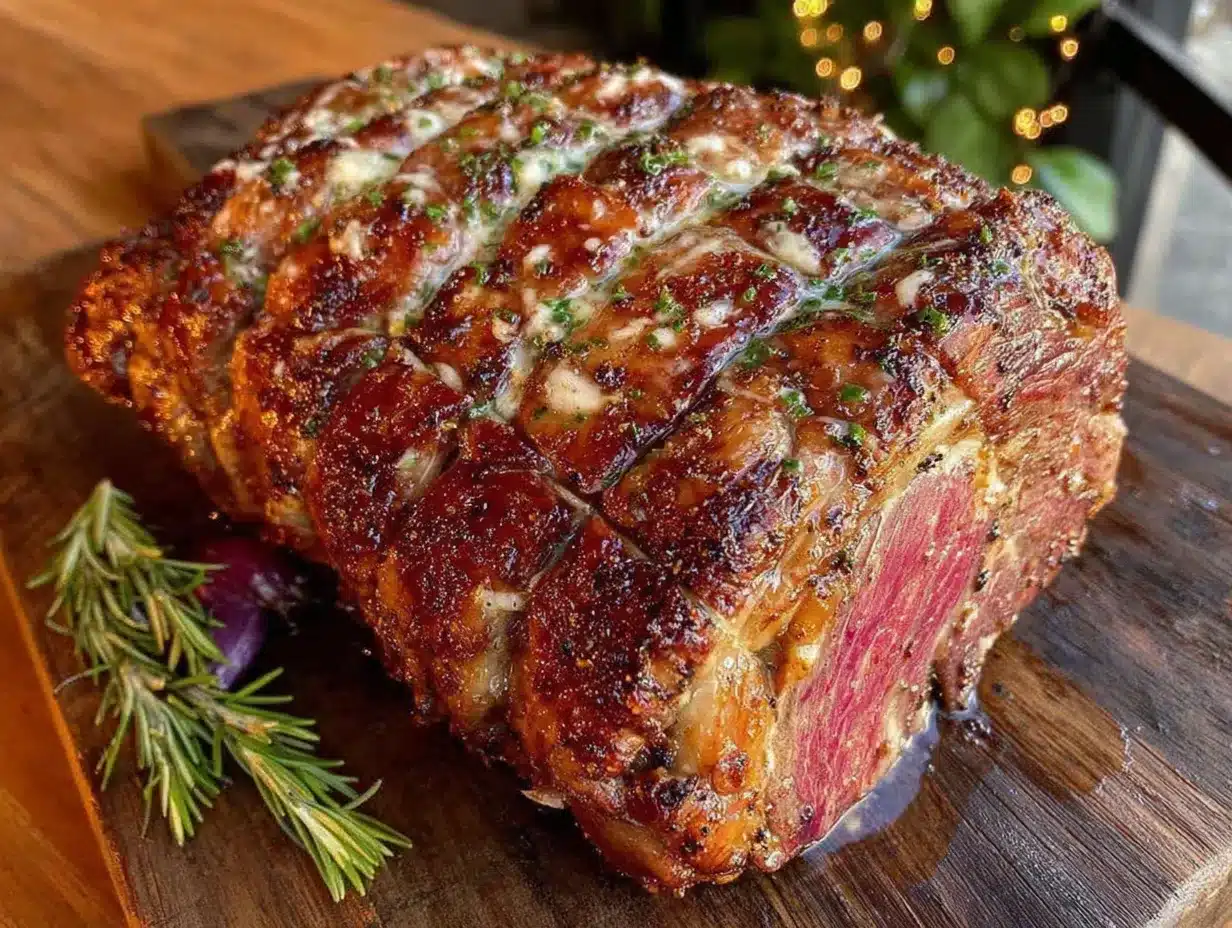
- 1 (6-8 pound) bone-in prime rib roast (ask your butcher for a first-cut or standing rib roast, 3-4 bones)
- 2 tablespoons kosher salt (for dry-brining)
- 1 tablespoon black pepper, freshly ground
- 1 tablespoon fresh rosemary, finely chopped (extra for the crust)
- 1 tablespoon fresh thyme leaves (extra for the crust)
- 1 cup beef broth (low-sodium, for the au jus)
- 1/2 cup dry red wine (optional, but adds depth to the jus)
Ingredient Selection Tips: Look for a roast with good marbling — those white streaks of fat running through the meat are what keep it juicy. The bones add flavor and act as a natural roasting rack. If your roast is boneless, you’ll need to adjust the cooking time slightly (it will cook faster) and place it on a wire rack in the pan. For the best flavor, use fresh herbs. Dried herbs are more concentrated, so if you must substitute, use one-third of the amount. I’ve tried this with dried rosemary once, and honestly, it just wasn’t the same — the fresh stuff really shines here.
Substitution Guidance: If you can’t find fresh rosemary, you can use dried, but reduce it to 2 teaspoons. For a dairy-free option, you can use a high-quality vegan butter, but the flavor will be slightly different. If you don’t drink wine, just use more beef broth for the au jus. The recipe is forgiving, but the butter is non-negotiable — it’s what makes the crust so incredible.
Equipment Needed
You don’t need a professional kitchen to make this roast, but having the right tools makes the process smoother. Here’s what I use:
- Large roasting pan with a rack (if you don’t have a rack, roll up some foil into coils to elevate the roast)
- Instant-read meat thermometer (this is non-negotiable — trust me, I’ve ruined enough roasts guessing)
- Chef’s knife for trimming and carving
- Small bowl for mixing the herb butter
- Kitchen twine to tie the roast (your butcher might do this for you)
- Aluminum foil for resting
- Small saucepan for the au jus
- Cutting board with a groove to catch juices
I bought my roasting pan at a restaurant supply store for about thirty bucks, and it’s lasted me ten years. You don’t need anything fancy — just something sturdy that can handle high heat. If you’re using a disposable pan, double it up so it doesn’t buckle under the weight. And please, for the love of good food, get a reliable thermometer. I use a Thermapen, but any instant-read will work. It’s the difference between a perfect roast and a sad, dry piece of meat.
Preparation Method
This method might seem involved, but I promise it’s straightforward. The key is patience and letting the meat do its thing. Here’s how to get that perfect prime rib:
- Prepare the roast (24 hours before cooking): Pat the prime rib dry with paper towels. Season it generously all over with 2 tablespoons of kosher salt and 1 tablespoon of black pepper. Don’t be shy — most of it will fall off during cooking. Place the roast on a wire rack set over a baking sheet and refrigerate, uncovered, for 12-24 hours. This dry-brine step is what gives you that deeply seasoned meat and a beautiful crust. I learned this trick from a J. Kenji López-Alt article, and it changed my roasting game completely.
- Make the herb butter (up to 3 days ahead): In a small bowl, combine the softened butter, minced garlic, chopped rosemary, thyme, parsley, salt, pepper, and red pepper flakes if using. Mix until everything is evenly distributed. The butter should be spreadable but not melty. If you’re making it ahead, roll it into a log in plastic wrap and refrigerate. Let it come to room temperature before using.
- Bring the roast to room temperature: About 2-3 hours before cooking, take the roast out of the fridge and let it sit on the counter. This step is crucial — a cold roast will cook unevenly. You want the internal temperature to come up to around 60°F before it goes in the oven. I usually set a timer so I don’t forget.
- Preheat the oven: Set your oven to 250°F (120°C). Yes, this is low. Trust the process. Place a rack in the lower third of the oven.
- Apply the herb butter: Pat the roast dry again with paper towels (this helps the butter stick). Rub the herb butter all over the roast, getting into every crevice. Don’t forget the ends. The butter will look like a thick, green paste — that’s perfect.
- Roast low and slow: Place the roast bone-side down on a rack in your roasting pan. Insert your meat thermometer into the thickest part of the meat, avoiding the bone. Roast at 250°F until the internal temperature reaches 120°F for rare, 125°F for medium-rare, or 130°F for medium. This usually takes about 3-4 hours for a 6-8 pound roast, but every oven is different. Start checking at the 2.5-hour mark. The roast will look pale and unappetizing at this point — don’t panic.
- Rest and crank the heat: Once the roast hits your target temperature, remove it from the oven. Tent it loosely with foil and let it rest for 30 minutes. Meanwhile, increase the oven temperature to 500°F (260°C). This rest is critical — it allows the juices to redistribute so they don’t run out when you carve.
- Sear the crust: After the rest, remove the foil and return the roast to the 500°F oven. Roast for 8-12 minutes, until the exterior is deeply browned and crusty. Watch it carefully — it can go from perfect to burnt in seconds. The butter and herbs will sizzle and create the most incredible aroma. When it’s done, remove it from the oven and let it rest for another 10-15 minutes before carving.
- Make the au jus: While the roast rests, place the roasting pan over two burners on medium heat. Add the beef broth and red wine (if using). Bring to a simmer, scraping up all the browned bits from the bottom of the pan. Let it reduce slightly, about 5 minutes. Strain through a fine-mesh sieve into a small saucepan. Season with salt and pepper to taste. Keep warm until serving.
- Carve and serve: Remove the kitchen twine and slice the roast between the bones to separate them. Then slice the meat against the grain into 1/2-inch thick slices. Arrange on a platter, spoon some au jus over the top, and serve the rest on the side.
Cooking Tips & Techniques
I’ve made this roast more times than I care to count, and I’ve learned a few things the hard way. Here are my best tips for success:
Don’t skip the dry brine. I know it seems like an extra step, but it makes a huge difference. The salt penetrates the meat, seasoning it from the inside out, and the uncovered rest in the fridge dries out the surface, which helps form that gorgeous crust. I once skipped this step when I was short on time, and the roast was noticeably less flavorful.
Use a thermometer, not a timer. This is the single most important piece of advice I can give you. Ovens vary, roasts vary, and guessing is a recipe for disaster. I’ve had a 6-pound roast take 3 hours and a 7-pound roast take 4.5 hours. The only way to know is to measure. Insert the thermometer from the side of the roast, not the top, and make sure it’s in the center of the meat, not touching bone.
Let it rest — twice. The first rest after the low-temperature cook allows the meat to cool slightly so the sear doesn’t overcook it. The second rest after the sear lets the juices settle. If you carve too soon, you’ll have a pool of juice on your cutting board and dry meat on your plate. I learned this lesson when I carved a roast for a dinner party and watched all the juices run out. It was heartbreaking.
Don’t overcrowd the pan. If you’re making vegetables or Yorkshire puddings alongside, don’t put them in the roasting pan with the meat. They’ll steam and prevent the crust from forming. Roast them separately. The pan needs to be mostly empty for the high-heat sear to work properly.
Save the bones. After carving, don’t throw away the bones. They’re perfect for making beef stock or for gnawing on when no one’s looking. I usually save them in a freezer bag and add them to my next batch of stock. They’re full of flavor.
Variations & Adaptations
This recipe is a fantastic base, but don’t be afraid to make it your own. Here are some ways I’ve adapted it over the years:
Herb Variations: The herb butter is endlessly customizable. Try using sage and marjoram for a more traditional holiday flavor. Or go with tarragon and chives for a French twist. In the summer, I sometimes add a tablespoon of fresh basil and a teaspoon of lemon zest. The key is to keep the total herb volume about the same — you want enough to flavor the butter without overpowering the meat.
Spice It Up: For a bolder flavor, add a tablespoon of Dijon mustard to the herb butter. Or mix in a teaspoon of smoked paprika and a pinch of cayenne for a smoky-sweet crust. I tried this once for a New Year’s Eve party and it was a huge hit. The mustard also helps the herb butter adhere to the meat.
Dietary Adaptations: For a dairy-free version, use a high-quality vegan butter. I’ve tried Miyoko’s and it works surprisingly well. The texture is slightly different, but the flavor is still excellent. For a lower-sodium option, reduce the salt in the dry brine and use unsalted butter. You can always add more salt at the table.
Cooking Method Variations: If you have a smoker, you can smoke the roast at 225°F for 3-4 hours before searing. The smoky flavor pairs beautifully with the herb butter. I did this for a Fourth of July barbecue and it was incredible. Just make sure to use wood chips that complement beef, like hickory or oak.
Smaller Roast Adaptation: Cooking for two? You can use a 2-3 pound boneless roast. Reduce the herb butter by half and cook at 250°F until it reaches 120°F, about 1.5-2 hours. The searing time stays the same. The dry brine time can be reduced to 6-8 hours.
Serving & Storage Suggestions
This roast is a showstopper, so serve it with pride. Here’s how to make the most of it:
Serving Temperature: Prime rib is best served warm, not hot. The ideal serving temperature is about 120-125°F for medium-rare. Let the roast rest fully before carving, and serve it on a warmed platter. Cold plates will cool the meat down too quickly.
Presentation: Arrange the sliced meat on a large platter, overlapping the slices slightly. Garnish with fresh rosemary sprigs and thyme. Serve the au jus in a separate gravy boat or small pitcher. I like to place the carved bones around the edge of the platter for a rustic look. It’s dramatic and beautiful.
What to Serve With It: This roast pairs beautifully with creamy mashed potatoes, roasted vegetables (like carrots and Brussels sprouts), Yorkshire puddings, or a simple green salad with a vinaigrette to cut the richness. For wine, a full-bodied Cabernet Sauvignon or a rich Merlot is perfect. The tannins in the wine complement the fat in the meat beautifully.
Storage: Leftover prime rib is a gift. Store it in an airtight container in the refrigerator for up to 4 days. The meat will continue to develop flavor as it sits. I actually love leftovers more than the initial meal — the flavors meld together overnight.
Reheating: The best way to reheat prime rib is low and slow. Place slices in a baking dish, add a splash of beef broth, cover with foil, and warm in a 300°F oven for 10-15 minutes. Don’t use the microwave — it will toughen the meat. You can also slice it thin and use it for sandwiches the next day. Cold prime rib on a crusty roll with horseradish sauce is one of life’s great pleasures.
Freezer: You can freeze cooked prime rib for up to 3 months. Wrap it tightly in plastic wrap, then foil, and place in a freezer bag. Thaw in the refrigerator overnight before reheating. The texture won’t be quite as perfect as fresh, but it’s still delicious.
Nutritional Information & Benefits
Let’s be real — prime rib is a special occasion indulgence, not an everyday meal. But it does have some nutritional benefits worth noting. A 4-ounce serving of prime rib (about the size of a deck of cards) contains approximately:
- Calories: 350-400
- Protein: 25-30 grams
- Fat: 28-32 grams
- Iron: 15% of the Daily Value
- Vitamin B12: 50% of the Daily Value
- Zinc: 25% of the Daily Value
Beef is an excellent source of high-quality protein, which is essential for muscle repair and growth. It’s also rich in iron, which helps carry oxygen in your blood, and vitamin B12, which supports nerve function. The fat content is higher than leaner cuts, but that’s what gives prime rib its incredible flavor and tenderness.
Dietary Considerations: This recipe is naturally gluten-free and low-carb. It’s suitable for keto and paleo diets. The main allergen is dairy from the butter, but as mentioned, you can substitute vegan butter. If you’re watching your sodium intake, reduce the salt in the dry brine and use unsalted butter.
My personal perspective? This is a meal for celebration, not for every day. It’s rich, indulgent, and absolutely worth every bite. I believe in enjoying food like this in moderation — savoring it fully when you have it, and balancing it with lighter meals the rest of the week. That’s the key to a healthy relationship with food.
Conclusion
This prime rib roast is more than just a recipe — it’s a memory I worked hard to recreate, and now it’s a tradition I look forward to every year. The herb butter, the slow roast, the perfect crust — it all comes together to create a meal that feels truly special. Whether you’re making it for Christmas dinner, a milestone birthday, or just because you want to feel like a culinary rockstar, this recipe delivers.
Don’t be intimidated by the size of the roast or the number of steps. Take it one step at a time, trust your thermometer, and remember that even if something goes wrong, it’s still going to be delicious. Cooking is about joy, not perfection. I’ve made this roast when I was tired, when I was stressed, and when I was celebrating, and it has never let me down.
I’d love to hear how yours turns out! Leave a comment below and let me know if you tried any variations, or share a photo of your roast on social media and tag me. Did you serve it with mashed potatoes? Did you try the smoked version? I read every comment and I love seeing your creations. Happy cooking, and here’s to making memories around the table!
Frequently Asked Questions
Can I use a boneless prime rib roast for this recipe?
Absolutely. A boneless roast will cook faster since there’s no bone to slow down heat transfer. Start checking the temperature about 30 minutes earlier than you would for a bone-in roast. The flavor will still be excellent, though the bone does add some extra richness. If you’re using a boneless roast, make sure to tie it with kitchen twine so it holds its shape.
How do I know when the prime rib is done without a thermometer?
Honestly, I strongly recommend using a thermometer. It’s the only reliable way to get consistent results. But if you absolutely have to go without, you can use the “touch test” — medium-rare meat feels like the fleshy part of your palm when you touch your thumb to your pinky finger. However, this method is very imprecise and I’ve ruined plenty of roasts guessing. Please just buy a thermometer. They’re cheap and they’ll save you a lot of disappointment.
Can I prepare the herb butter in advance?
Yes, and I actually recommend it. The herb butter can be made up to 3 days ahead and stored in the refrigerator. Let it come to room temperature for about 30 minutes before using so it’s spreadable. You can also freeze the butter for up to 3 months — just wrap it tightly in plastic wrap and place it in a freezer bag. Thaw it in the refrigerator overnight before using.
What if my roast is cooking too fast or too slow?
Every oven runs differently, so don’t panic if your timing doesn’t match mine. If the roast is cooking too fast, lower the oven temperature to 225°F. If it’s cooking too slow, increase it to 275°F. The key is to be flexible and let the meat tell you when it’s done. Your thermometer is your best friend here. Just remember that the roast will continue to cook while it rests, so pull it out about 5°F before your target temperature.
Can I use dried herbs instead of fresh?
You can, but I don’t recommend it for this recipe. Fresh herbs have a brightness and aroma that dried herbs just can’t match. If you must use dried, use one-third of the amount called for in the recipe. So instead of 2 tablespoons of fresh rosemary, use 2 teaspoons of dried. The flavor will be more concentrated and slightly different, but it will still be good. Just know that the fresh version is truly something special.
Pin This Recipe!
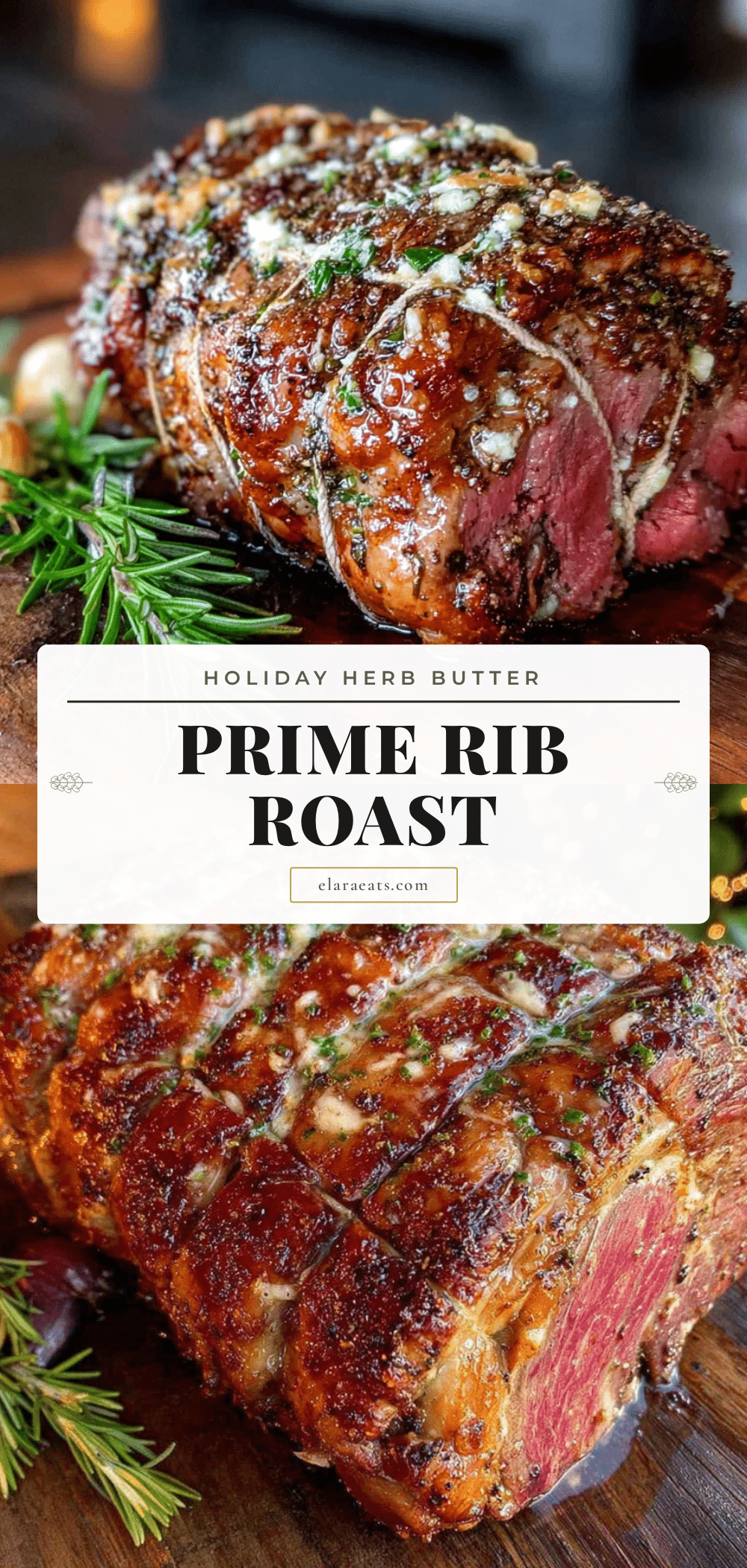
Perfect Holiday Prime Rib Roast with Easy Herb Butter
This foolproof prime rib roast uses a reverse-sear technique and a flavorful herb butter to deliver a perfectly cooked, tender, and juicy centerpiece for any celebration. It’s a restaurant-quality dish made simple with fresh ingredients and patience.
- Prep Time: 30 minutes
- Cook Time: 3 hours 30 minutes
- Total Time: 4 hours (plus 12-24 hours dry brine and 2-3 hours resting)
- Yield: 8-10 servings 1x
- Category: Main Course
- Cuisine: American
Ingredients
- 1 cup (2 sticks) unsalted butter, softened
- 4 cloves garlic, minced
- 2 tablespoons fresh rosemary, finely chopped
- 2 tablespoons fresh thyme leaves, chopped
- 1 tablespoon fresh parsley, finely chopped
- 1 teaspoon kosher salt
- 1/2 teaspoon black pepper, freshly ground
- 1/2 teaspoon red pepper flakes (optional)
- 1 (6-8 pound) bone-in prime rib roast (first-cut or standing rib roast, 3–4 bones)
- 2 tablespoons kosher salt (for dry-brining)
- 1 tablespoon black pepper, freshly ground
- 1 tablespoon fresh rosemary, finely chopped (extra for crust)
- 1 tablespoon fresh thyme leaves (extra for crust)
- 1 cup low-sodium beef broth
- 1/2 cup dry red wine (optional)
Instructions
- Prepare the roast (24 hours before cooking): Pat the prime rib dry with paper towels. Season generously with 2 tablespoons kosher salt and 1 tablespoon black pepper. Place on a wire rack over a baking sheet and refrigerate, uncovered, for 12-24 hours.
- Make the herb butter (up to 3 days ahead): In a small bowl, combine softened butter, minced garlic, chopped rosemary, thyme, parsley, salt, pepper, and red pepper flakes (if using). Mix until evenly distributed. Refrigerate if making ahead; bring to room temperature before using.
- Bring the roast to room temperature: About 2-3 hours before cooking, remove roast from fridge and let sit on counter until internal temperature reaches about 60°F.
- Preheat the oven to 250°F (120°C). Place a rack in the lower third of the oven.
- Apply the herb butter: Pat the roast dry with paper towels. Rub herb butter all over the roast, covering every crevice.
- Roast low and slow: Place roast bone-side down on a rack in a roasting pan. Insert a meat thermometer into the thickest part, avoiding bone. Roast at 250°F until internal temperature reaches 120°F for rare, 125°F for medium-rare, or 130°F for medium (about 3-4 hours for a 6-8 pound roast). Start checking at 2.5 hours.
- Rest and crank the heat: Remove roast from oven, tent loosely with foil, and let rest for 30 minutes. Increase oven temperature to 500°F (260°C).
- Sear the crust: Remove foil and return roast to 500°F oven. Roast for 8-12 minutes until deeply browned and crusty. Watch carefully. Remove and let rest another 10-15 minutes before carving.
- Make the au jus: Place roasting pan over two burners on medium heat. Add beef broth and red wine (if using). Bring to a simmer, scraping up browned bits. Let reduce about 5 minutes. Strain through a fine-mesh sieve into a small saucepan. Season with salt and pepper to taste. Keep warm.
- Carve and serve: Remove kitchen twine. Slice between bones to separate, then slice meat against the grain into 1/2-inch thick slices. Arrange on a platter, spoon some au jus over the top, and serve remaining on the side.
Notes
Don’t skip the dry brine; it deeply seasons the meat and helps form a crust. Use a thermometer for perfect doneness. Let the roast rest twice for juicy results. Save the bones for stock.
Nutrition
- Serving Size: 4 ounces
- Calories: 375
- Sodium: 800
- Fat: 30
- Saturated Fat: 15
- Carbohydrates: 1
- Protein: 28
Keywords: prime rib, holiday roast, herb butter, reverse sear, Christmas dinner, beef roast, special occasion