Love this? Save it for later!
Share the inspiration with your friends
I wasn’t expecting baking advice from my accountant, but there I was, sitting in his cluttered office during tax season, watching him sketch a diagram of a braided pastry on a sticky note. “You need to make this for Mardi Gras,” he said, sliding the note across the desk. “My grandmother from Bayou St. John taught me, and it’s the only thing I know how to bake.” Let me tell you, when a man who spends his days staring at spreadsheets gets passionate about pastry, you pay attention. He drew little arrows showing where the cream cheese filling should go and circled the spot where you hide the plastic baby. Honestly, I almost forgot to ask about my deductions.
That sticky note stayed taped to my kitchen cabinet for three months before I finally gathered the courage to try it. The first attempt was a mess — the filling leaked out, the braid looked more like a tangled garden hose, and I forgot to add the cinnamon. But there was something about that slightly lopsided, gooey, purple-and-green-splotched cake that made everyone at my dinner party go quiet. I mean, actually quiet. You know that feeling when a dessert stops conversation cold? That’s what this Best New Orleans King Cake with Cream Cheese Filling does.
I’ve since made this recipe about twenty times, tweaking it until it felt like mine. I added a bit more lemon zest to the cream cheese. I figured out the trick to keeping the filling from oozing out during baking. And I learned that the colored sugars — purple for justice, green for faith, gold for power — aren’t just decoration. They’re the whole point. Every time I pull this golden, sugar-crusted ring out of the oven, I think of that accountant and his grandmother, and I swear I can hear a second line parade starting somewhere in the distance. This is the king cake that makes people ask for the recipe before they even finish their slice.
Why You’ll Love This Recipe
This Best New Orleans King Cake with Cream Cheese Filling isn’t just another Mardi Gras dessert — it’s the one that’ll have your guests hovering around the kitchen island waiting for it to cool. I’ve tested this recipe more times than I care to admit, and I can tell you with confidence: this is the version worth making.
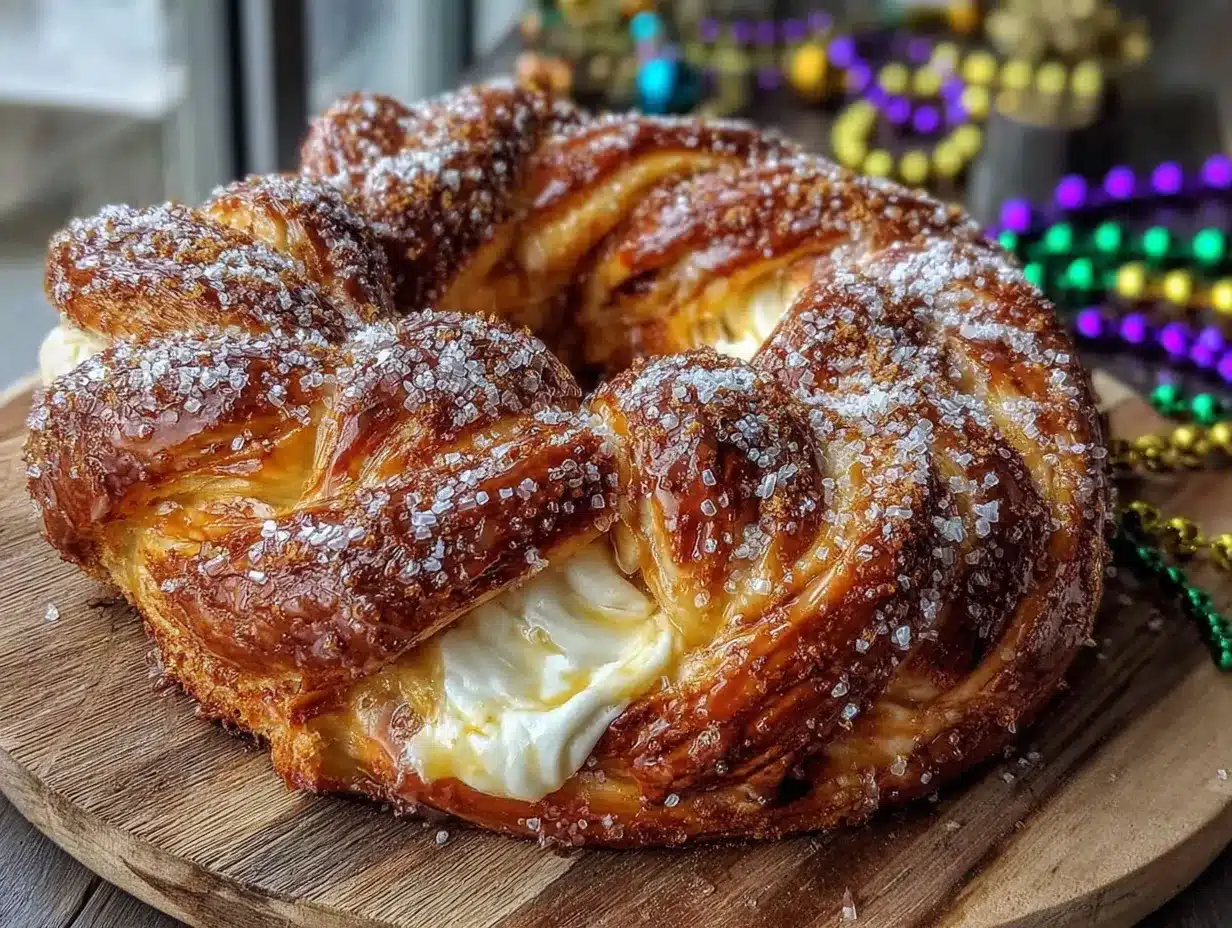
- Show-Stopping Presentation : The braided ring covered in purple, green, and gold sugar is pure drama. It sits on the table like a crown — which, honestly, is exactly the point.
- Cream Cheese Filling That Stays Put : No more sad, empty pockets where the filling escaped. This recipe uses a technique that locks the cream cheese right where you want it.
- Perfect for a Crowd : This cake serves 12 to 16 people easily. It’s ideal for your Mardi Gras party, Fat Tuesday brunch, or any gathering where you want to impress without spending all day in the kitchen.
- Make-Ahead Friendly : You can prep the dough the night before and bake it fresh the day of your party. Your future self will thank you.
- That Unforgettable First Bite : The combination of soft, buttery brioche-style dough, tangy-sweet cream cheese, and that crackly sugar crust is pure magic. It’s the kind of dessert that makes people close their eyes and groan.
What makes this recipe different from all the others? It’s the balance. The dough is enriched but not heavy. The filling is creamy but not cloying. And the sugar topping — oh, that sugar topping — has just the right crunch to contrast with the pillowy bread. I’ve spent years perfecting the ratios so you don’t have to. This is the king cake that tastes like it came from a French Quarter bakery, but it comes from your very own kitchen.
What Ingredients You Will Need
This recipe uses ingredients that build layers of flavor and texture. Most of them are pantry staples, but a few special touches make all the difference. Here’s what you’ll need and why each one matters.
For the Dough
- 3 ½ cups (440g) all-purpose flour — Plus extra for dusting. I prefer King Arthur Flour for consistent results.
- ¼ cup (50g) granulated sugar — Just enough sweetness to balance the tangy filling.
- 1 packet (2 ¼ tsp) active dry yeast — Make sure it’s fresh. Old yeast is the #1 reason homemade bread fails.
- 1 teaspoon salt — Don’t skip it. Salt controls the yeast and brings out the flavor.
- ½ cup (120ml) whole milk, warmed to 110°F — The warmth wakes up the yeast. Too hot will kill it, so use a thermometer if you have one.
- ¼ cup (60ml) water, warmed to 110°F — Same temperature as the milk for consistent dough hydration.
- 2 large eggs, room temperature — Cold eggs will shock the dough. Leave them on the counter for 30 minutes.
- 1 large egg yolk, room temperature — Extra yolk adds richness and that beautiful golden crumb.
- 6 tablespoons (85g) unsalted butter, softened — European-style butter like Plugrà gives a richer flavor, but any unsalted butter works.
- 1 teaspoon vanilla extract — Pure vanilla, not imitation. It makes a noticeable difference.
- ½ teaspoon freshly grated nutmeg — This is the secret ingredient that gives king cake its distinctive warmth. Grate it fresh if you can.
For the Cream Cheese Filling
- 8 oz (226g) cream cheese, softened — Full-fat is non-negotiable here. Low-fat cream cheese gets watery and won’t hold its shape.
- ¼ cup (50g) granulated sugar — Just enough to sweeten without overpowering the tang.
- 1 large egg yolk — This thickens the filling and prevents it from leaking during baking.
- 1 teaspoon vanilla extract — Again, pure vanilla.
- 1 tablespoon all-purpose flour — The secret stabilizer. This tiny addition keeps the filling from turning into a puddle.
- Zest of 1 lemon — Don’t skip this. The lemon brightens the cream cheese and cuts through the richness of the dough.
For the Topping
- 1 cup (120g) powdered sugar — For the glaze.
- 2-3 tablespoons milk — Adjust to reach drizzling consistency.
- ¼ cup (50g) purple sanding sugar — You can find this at craft stores or online. Regular colored sugar works too, but sanding sugar has that satisfying crunch.
- ¼ cup (50g) green sanding sugar — Same deal. Make your own by mixing regular sugar with gel food coloring if you can’t find it pre-made.
- ¼ cup (50g) gold or yellow sanding sugar — Gold is traditional, but yellow works in a pinch.
- 1 small plastic baby (optional but traditional) — Hide it in the cake after baking. Whoever finds it gets good luck — and has to host next year’s party.
Equipment Needed
You don’t need a professional bakery setup for this recipe, but a few specific tools will make your life much easier. I’ve made this cake with minimal equipment and it worked, but here’s what I recommend for the best results.
- Stand mixer with dough hook — This dough is soft and sticky, and kneading by hand takes about 15 minutes. A stand mixer does it in 8 and saves your arms. If you don’t have one, a large bowl and a wooden spoon will work — just be prepared for a workout.
- Instant-read thermometer — Yeast is finicky about temperature. This $10 tool prevents you from killing your yeast with overheated milk.
- Large baking sheet — A half-sheet pan (18×13 inches) is perfect. Line it with parchment paper for easy cleanup.
- Rolling pin — For rolling the dough into that big rectangle.
- Pastry brush — For applying the glaze. A silicone brush works great and doesn’t shed bristles.
- Plastic wrap or a clean kitchen towel — For covering the dough while it rises.
- Piping bag or zip-top bag — For piping the cream cheese filling. A zip-top bag with the corner snipped off works perfectly and costs nothing.
Budget-friendly tip: If you don’t have sanding sugar, you can make your own by combining regular granulated sugar with gel food coloring. Spread it on a baking sheet and let it dry for an hour before using. It’s not quite as crunchy, but it looks just as festive.
Preparation Method
Let’s walk through this step by step. I’ve included time estimates and sensory cues so you know exactly what to look for at each stage. Take your time — good bread rewards patience.
Step 1: Activate the Yeast (10 minutes)
In the bowl of your stand mixer, combine the warmed milk, warmed water, and 1 tablespoon of the sugar. Sprinkle the yeast on top and let it sit for 5-10 minutes until it becomes foamy and smells like fresh bread. If it doesn’t foam, your yeast is dead — start over with fresh yeast. This step is where most people mess up, so don’t rush it.
Step 2: Make the Dough (15 minutes)
Add the remaining sugar, salt, eggs, egg yolk, vanilla extract, nutmeg, and 2 cups of the flour to the yeast mixture. Mix on low speed with the dough hook until combined, about 2 minutes. Add the softened butter a tablespoon at a time, letting each piece incorporate before adding the next. Gradually add the remaining flour, ½ cup at a time, until the dough pulls away from the sides of the bowl but still feels soft and slightly tacky. You might not need all the flour — stop when the dough feels like your earlobe (yes, that’s the actual test bakers use). Knead on medium-low speed for 8 minutes. The dough should be smooth, elastic, and slightly shiny.
Step 3: First Rise (1 to 1.5 hours)
Transfer the dough to a lightly greased bowl, turning once to coat. Cover tightly with plastic wrap and let it rise in a warm, draft-free spot until doubled in size. This takes about 60-90 minutes. The dough should look puffy and feel airy when you poke it. If your kitchen is cold, place the bowl in your oven with the light on — it creates the perfect proofing environment.
Step 4: Make the Cream Cheese Filling (10 minutes)
While the dough rises, make the filling. Beat the softened cream cheese and sugar together until smooth and creamy. Add the egg yolk, vanilla, lemon zest, and flour, and beat until combined. Don’t overmix — you want it smooth, not aerated. Transfer the filling to a piping bag or a zip-top bag and set aside at room temperature. If you make it ahead, let it come back to room temperature before using — cold filling won’t spread evenly.
Step 5: Shape the Cake (20 minutes)
Punch down the risen dough and turn it out onto a lightly floured surface. Roll it into a 24×10-inch rectangle — about the size of a large baking sheet. Don’t stress about perfect measurements; just get it close. Using your piping bag, pipe the cream cheese filling in a straight line down the center of the rectangle, leaving about 1 inch of bare dough at each end. Fold one side of the dough over the filling, then fold the other side over to meet it. Pinch the seam and the ends to seal. Carefully transfer the log to your parchment-lined baking sheet, seam-side down. Bring the ends together to form a ring and pinch them to seal. Don’t worry if it looks lumpy — the glaze and sugar will cover any imperfections.
Step 6: Second Rise (45 minutes)
Cover the shaped ring loosely with plastic wrap and let it rise again until puffy and almost doubled, about 45 minutes. It should look pillowy and soft. This second rise is crucial — don’t skip it or rush it. A properly proofed king cake bakes up light and tender instead of dense and bready.
Step 7: Bake the Cake (25-30 minutes)
Preheat your oven to 350°F (175°C) during the last 15 minutes of the second rise. Bake the cake on the center rack for 25-30 minutes, until it’s deep golden brown and sounds hollow when you tap the bottom. If the top is browning too quickly, tent it loosely with foil after 15 minutes. Let the cake cool on the baking sheet for 10 minutes, then transfer to a wire rack to cool completely. Don’t skip the cooling time — warm glaze will just slide right off.
Step 8: Glaze and Decorate (15 minutes)
Once the cake is completely cool, make the glaze. Whisk the powdered sugar with 2 tablespoons of milk until smooth. Add more milk a teaspoon at a time if it’s too thick — you want it thick enough to coat the back of a spoon but thin enough to drizzle. Drizzle the glaze over the top of the cake, letting it drip down the sides. While the glaze is still wet, sprinkle the colored sugars in alternating bands — purple, green, gold — all the way around the ring. If you’re hiding a plastic baby, push it into the bottom of the cake from underneath. Let the glaze set for about 20 minutes before serving.
Cooking Tips & Techniques
I’ve made this Best New Orleans King Cake with Cream Cheese Filling more times than I can count, and I’ve learned a few things the hard way. Here are the tips that make the difference between a good king cake and a great one.
Keep your ingredients at room temperature. I cannot stress this enough. Cold cream cheese creates lumpy filling. Cold eggs shock the dough. Cold butter doesn’t incorporate properly. Set everything on the counter at least 30 minutes before you start. Your future cake will thank you.
Don’t overthink the braiding. Some king cake recipes call for cutting the dough into strips and braiding them. I’ve tried that method, and honestly, the filling always leaks out. The folded log method I use here is simpler and more reliable. The filling stays sealed inside, and the cake bakes up evenly. Trust me on this one.
Use a thermometer for your liquids. I killed my yeast three times before I bought a $10 instant-read thermometer. Yeast wakes up at about 105-115°F. Anything over 130°F kills it. If you don’t have a thermometer, the milk should feel like warm bath water — comfortable to touch, not hot.
Let the cake cool completely before glazing. This is the mistake I made on my first attempt. The warm cake melted the glaze into a sticky puddle, and all the colored sugar bled together into a brown mess. Patience is not my strong suit, but it’s essential here. Give it a full hour on the wire rack.
Make your own colored sugar if you can’t find it. I once drove to three different stores looking for purple sanding sugar and came home empty-handed. Now I make my own by mixing ¼ cup granulated sugar with a drop of gel food coloring in a zip-top bag. Shake it until the color is even, spread it on a plate, and let it dry for an hour. It works perfectly and costs pennies.
Variations & Adaptations
One of the best things about this Best New Orleans King Cake with Cream Cheese Filling is how adaptable it is. Here are some variations I’ve tried and loved.
Chocolate Cream Cheese Filling : Add 2 tablespoons of unsweetened cocoa powder and ¼ cup of mini chocolate chips to the cream cheese filling. The chocolate pairs beautifully with the cinnamon-spiced dough. My kids beg for this version every Mardi Gras.
Gluten-Free Version : Substitute the all-purpose flour with a high-quality gluten-free flour blend that contains xanthan gum. Cup4Cup works well here. The dough will be stickier and harder to handle, so flour your surface generously. The texture won’t be quite as fluffy, but the flavor is still fantastic.
Dairy-Free Adaptation : Use vegan butter, oat milk, and dairy-free cream cheese. Miyoko’s cream cheese is my favorite for baking — it has the right tang and doesn’t get watery. The dough will be slightly less rich, but it’s still delicious.
Fruit-Filled King Cake : Swap the cream cheese filling for a layer of raspberry jam, apple butter, or lemon curd. Spread it thinly over the dough rectangle before rolling. No need to pipe it — just spread it with an offset spatula. This version is less rich and perfect for brunch.
Individual King Cake Rolls : Instead of shaping one large ring, cut the filled log into 12 equal pieces and arrange them in a greased 9×13 baking dish. Bake for 20-22 minutes. These are perfect for parties where everyone wants their own little piece of the tradition.
Serving & Storage Suggestions
This king cake is best served at room temperature on the day it’s baked. The glaze stays slightly crackly, the dough is soft, and the filling is perfectly creamy. If you’re hosting a party, bake it the morning of your gathering and let it cool while you prep everything else.
For presentation, place the cake on a large round platter or a wooden board. The colored sugars make it naturally festive, so you don’t need much else. A few strands of Mardi Gras beads draped around the platter add a nice touch. I like to set it out with small plates and napkins so guests can help themselves — it’s a cake that begs to be shared.
For storage, wrap any leftover cake tightly in plastic wrap and keep it at room temperature for up to 2 days. Do not refrigerate it — the fridge dries out the dough and makes the cream cheese filling firm and unappealing. If you need to keep it longer, slice the cake into individual pieces, wrap each piece in plastic wrap, and freeze for up to 1 month. Thaw at room temperature for about 30 minutes before serving.
For reheating, pop individual slices in a 300°F oven for 5-7 minutes. The dough will soften and the filling will warm up, but the glaze won’t be as pretty. Honestly, I prefer it at room temperature — the flavors are more balanced, and the texture is just right.
Nutritional Information & Benefits
Let’s be real — this is a celebration cake, not a health food. But here’s what you’re looking at per slice (based on 14 servings): approximately 380 calories, 16g fat, 52g carbohydrates, 8g protein, and 24g sugar. The cream cheese filling adds protein and calcium, and the eggs provide a good dose of vitamin D and B12.
The lemon zest in the filling isn’t just for flavor — it adds a touch of vitamin C and brightens the whole dish. And while the colored sugar is mostly for looks, there’s something to be said for the joy it brings. A little celebration is good for the soul, you know?
If you’re watching your sugar intake, you can reduce the sugar in the dough by a tablespoon or two without affecting the texture. The glaze is harder to reduce — it needs the sugar for structure — but you can make a lighter version by mixing powdered sugar with a splash of lemon juice instead of milk. It’ll be tangier and less sweet, which pairs beautifully with the cream cheese.
This recipe contains gluten, dairy, and eggs. For allergen-friendly versions, check the variations section above.
Conclusion
This Best New Orleans King Cake with Cream Cheese Filling is more than just a Mardi Gras dessert — it’s a tradition you can build around. Every time I make it, I think about that accountant and his grandmother, and I feel connected to something bigger than just a recipe. That’s the magic of king cake. It brings people together, sparks conversations, and creates memories that last long after the last crumb is gone.
I hope you’ll give this recipe a try, whether it’s for Fat Tuesday, a dinner party, or just a Tuesday that needs a little extra color. Don’t be afraid to make it your own — swap the filling, change the colors, hide the baby wherever you want. That’s the beauty of cooking. You take something traditional and you make it yours.
When you make this king cake, I’d love to hear about it. Drop a comment below and tell me how it turned out. Did you hide the baby? Did anyone find it? What variations did you try? Your stories are what make this community so special, and I read every single comment. Now go preheat that oven — Mardi Gras is calling.
Frequently Asked Questions
Can I make this king cake ahead of time?
Absolutely. You can prepare the dough through the first rise, punch it down, wrap it tightly in plastic wrap, and refrigerate it overnight. The next day, let it sit at room temperature for 30 minutes before shaping and proceeding with the recipe. You can also bake the cake a day ahead and store it wrapped at room temperature — just glaze it on the day you plan to serve it.
Do I have to hide a plastic baby in the cake?
It’s traditional, but totally optional. The plastic baby symbolizes luck and prosperity, and the person who finds it is supposed to host next year’s Mardi Gras party. If you’re serving kids or just don’t love the idea of a hidden object in your cake, feel free to skip it. The cake is delicious either way.
Why did my cream cheese filling leak out?
This usually happens for one of three reasons: the filling was too cold when you piped it, the dough wasn’t sealed properly at the seam, or you overfilled the cake. Make sure your cream cheese filling is at room temperature, pinch the seam firmly, and don’t pipe more than about ½ cup of filling. The flour in the filling also helps prevent leakage, so don’t skip it.
Can I use rapid-rise yeast instead of active dry yeast?
Yes, you can. Use the same amount (2 ¼ teaspoons) but skip the activation step. Mix the yeast directly with the flour and other dry ingredients, then add the warm liquids. The rising times will be slightly shorter, so keep an eye on the dough.
How do I get the colored sugar to stick without the glaze running?
The key is letting the glaze set for about 2-3 minutes before adding the sugar. If the glaze is too wet, the sugar will dissolve and the colors will bleed. If it’s too dry, the sugar won’t stick. Aim for a thick, drizzly consistency — the glaze should coat the back of a spoon but still flow slowly. Apply the sugar in bands while the glaze is still tacky but not wet.
Pin This Recipe!

Best New Orleans King Cake with Cream Cheese Filling
This Best New Orleans King Cake with Cream Cheese Filling is a show-stopping Mardi Gras dessert featuring a soft, buttery brioche-style dough, a tangy-sweet cream cheese filling that stays put, and a crackly purple, green, and gold sugar crust. Perfect for a crowd and make-ahead friendly, it’s the king cake that tastes like it came from a French Quarter bakery.
- Prep Time: 30 minutes
- Cook Time: 30 minutes
- Total Time: 3 hours 30 minutes
- Yield: 14 servings 1x
- Category: Dessert
- Cuisine: Cajun/Creole
Ingredients
- 3 ½ cups (440g) all-purpose flour, plus extra for dusting
- ¼ cup (50g) granulated sugar
- 1 packet (2 ¼ tsp) active dry yeast
- 1 teaspoon salt
- ½ cup (120ml) whole milk, warmed to 110°F
- ¼ cup (60ml) water, warmed to 110°F
- 2 large eggs, room temperature
- 1 large egg yolk, room temperature
- 6 tablespoons (85g) unsalted butter, softened
- 1 teaspoon vanilla extract
- ½ teaspoon freshly grated nutmeg
- 8 oz (226g) cream cheese, softened
- ¼ cup (50g) granulated sugar (for filling)
- 1 large egg yolk (for filling)
- 1 teaspoon vanilla extract (for filling)
- 1 tablespoon all-purpose flour (for filling)
- Zest of 1 lemon
- 1 cup (120g) powdered sugar
- 2–3 tablespoons milk
- ¼ cup (50g) purple sanding sugar
- ¼ cup (50g) green sanding sugar
- ¼ cup (50g) gold or yellow sanding sugar
- 1 small plastic baby (optional)
Instructions
- Activate the Yeast: In the bowl of a stand mixer, combine the warmed milk, warmed water, and 1 tablespoon of the sugar. Sprinkle the yeast on top and let it sit for 5-10 minutes until foamy.
- Make the Dough: Add the remaining sugar, salt, eggs, egg yolk, vanilla extract, nutmeg, and 2 cups of the flour to the yeast mixture. Mix on low speed with the dough hook until combined, about 2 minutes. Add the softened butter a tablespoon at a time, letting each piece incorporate before adding the next. Gradually add the remaining flour, ½ cup at a time, until the dough pulls away from the sides of the bowl but still feels soft and slightly tacky. Knead on medium-low speed for 8 minutes until …
- First Rise: Transfer the dough to a lightly greased bowl, turning once to coat. Cover tightly with plastic wrap and let it rise in a warm, draft-free spot until doubled in size, about 60-90 minutes.
- Make the Cream Cheese Filling: Beat the softened cream cheese and sugar together until smooth and creamy. Add the egg yolk, vanilla, lemon zest, and flour, and beat until combined. Transfer to a piping bag or zip-top bag and set aside at room temperature.
- Shape the Cake: Punch down the risen dough and turn it out onto a lightly floured surface. Roll it into a 24×10-inch rectangle. Pipe the cream cheese filling in a straight line down the center, leaving about 1 inch of bare dough at each end. Fold one side of the dough over the filling, then the other side to meet it. Pinch the seam and ends to seal. Transfer to a parchment-lined baking sheet, seam-side down. Bring the ends together to form a ring and pinch to seal.
- Second Rise: Cover the shaped ring loosely with plastic wrap and let it rise until puffy and almost doubled, about 45 minutes.
- Bake the Cake: Preheat oven to 350°F (175°C) during the last 15 minutes of the second rise. Bake on the center rack for 25-30 minutes, until deep golden brown and sounds hollow when tapped. If browning too quickly, tent with foil after 15 minutes. Cool on the baking sheet for 10 minutes, then transfer to a wire rack to cool completely.
- Glaze and Decorate: Once the cake is completely cool, whisk the powdered sugar with 2 tablespoons of milk until smooth. Add more milk a teaspoon at a time if too thick. Drizzle the glaze over the top of the cake. While the glaze is still wet, sprinkle the colored sugars in alternating bands — purple, green, gold — all the way around the ring. If hiding a plastic baby, push it into the bottom of the cake from underneath. Let the glaze set for about 20 minutes before serving.
Notes
Keep all ingredients at room temperature. Use a thermometer for liquids to avoid killing the yeast. Let the cake cool completely before glazing. Make your own colored sugar by mixing granulated sugar with gel food coloring if needed. The folded log method is simpler and more reliable than braiding.
Nutrition
- Serving Size: 1 slice (1/14 of cak
- Calories: 380
- Sugar: 24
- Sodium: 280
- Fat: 16
- Saturated Fat: 9
- Carbohydrates: 52
- Fiber: 1
- Protein: 8
Keywords: king cake, Mardi Gras, cream cheese, New Orleans, brioche, braided, festive, party dessert