Love this? Save it for later!
Share the inspiration with your friends
I was in the middle of a truly disastrous attempt at organizing my spice cabinet—don’t ask, it involved turmeric on the ceiling—when my accountant called. Not for taxes, but for bread advice. I know, it’s the last place you’d expect a recipe to come from, but there I was, holding a jar of cumin and listening to Mr. Henderson describe exactly how to make this easy same-day sourdough focaccia with rosemary. He wasn’t a foodie or a chef. He was the guy who does my quarterly estimates, and apparently, he’s been making this focaccia every Friday for the last fifteen years.
Honestly, I almost didn’t try it. I mean, my accountant? But he was so specific about the technique—”Let the dough tell you when it’s ready, not the clock”—that I had to give it a shot. The first time I made this easy same-day sourdough focaccia with rosemary, I burned the roof of my mouth because I couldn’t wait for it to cool. Worth it. The texture was this perfect paradox: crispy and golden on the outside, but so airy and tender on the inside that it practically melted.
Maybe you’ve been there, searching for a sourdough recipe that doesn’t require a two-day commitment or a PhD in fermentation. That’s what makes this one different. It uses a bubbly, active sourdough starter but comes together in a single afternoon. No stretch-and-folds every thirty minutes for eight hours. No complicated shaping. Just a wet, shaggy dough that you coax into something beautiful with a little patience and a lot of olive oil. And that rosemary? It gets all toasty and fragrant in the oven, filling your kitchen with the kind of smell that makes neighbors suddenly “stop by.” This recipe stayed with me because it proved that good things can come from unexpected sources—even a tax guy who calls on a Tuesday afternoon.
Why You’ll Love This Recipe
Let me tell you, I’ve tested a lot of focaccia recipes. Some were too dry, some were too dense, and some required a starter that was practically a pet. This easy same-day sourdough focaccia with rosemary is the one I keep coming back to, and here’s why you will too.
- Quick & Easy: From mixing to eating, this comes together in about 5 to 6 hours. That’s a same-day win for sourdough, which usually demands a full 24-hour timeline.
- Simple Ingredients: You need flour, water, salt, olive oil, your sourdough starter, and fresh rosemary. That’s it. No yeast packets, no fancy flours, no trips to a specialty store.
- Perfect for Any Occasion: It works for a casual weeknight dinner, a weekend brunch spread, or as a show-stopping side for soups and salads. It even makes incredible sandwich bread the next day.
- Crowd-Pleaser: I’ve brought this to potlucks and watched it disappear in minutes. Kids love the dimpled surface, and adults love the sophisticated rosemary flavor.
- Unbelievably Delicious: The contrast between the crisp, olive-oil-crusted bottom and the soft, airy crumb is next-level comfort food. It’s the kind of bread you eat with your hands, tearing off piece after piece.
What makes this recipe different from the rest is the technique. Instead of a complicated folding schedule, you use a high-hydration dough that develops strength through a long, slow bulk fermentation at room temperature. The result is a focaccia with an open crumb and a flavor that’s tangy and complex, not just salty. It’s comfort food reimagined—faster, easier, but with the same soul-soothing satisfaction. Perfect for impressing guests without stress, or turning a simple meal into something memorable.
What Ingredients You Will Need
This recipe uses simple, wholesome ingredients to deliver bold flavor and satisfying texture without the fuss. Most of these are pantry staples, especially if you already maintain a sourdough starter.
- Bread Flour: 500 grams (about 3 ¾ cups). I prefer King Arthur Bread Flour for its high protein content, which gives the focaccia its signature chewy texture. You can use all-purpose flour, but the crumb will be slightly less airy.
- Water: 400 grams (about 1 ¾ cups), lukewarm. Use filtered water if your tap water is heavily chlorinated, as chlorine can slow down fermentation.
- Active Sourdough Starter: 150 grams (about ¾ cup), bubbly and fed within the last 4-6 hours. This is the heart of the recipe. A hungry, sluggish starter won’t give you the rise you need.
- Extra-Virgin Olive Oil: 60 grams (about ¼ cup), plus more for the pan and for drizzling. Use a good-quality oil here—it’s a major flavor component. I like California Olive Ranch for a fruity, peppery note.
- Fine Sea Salt: 10 grams (about 1 ½ teaspoons). Don’t skip the salt. It controls fermentation and enhances the flavor of the sourdough.
- Fresh Rosemary: 2 tablespoons, finely chopped, plus more whole sprigs for topping. Dried rosemary won’t give you the same aromatic punch. If you only have dried, use half the amount and crush it between your fingers before adding.
- Flaky Sea Salt: For finishing. Maldon salt is my go-to. It adds a delightful crunch and a burst of salinity on top.
For the best texture, make sure your water is lukewarm—not hot, not cold. If your kitchen is cold (below 70°F), use slightly warmer water to help the fermentation along. When it comes to the rosemary, look for bright green, fragrant sprigs. Limp or yellowing rosemary is past its prime. You can also substitute fresh thyme or oregano for a different herbaceous twist, but rosemary is the classic pairing for a reason.
Equipment Needed
You don’t need a lot of fancy gear for this recipe, which is part of its charm. Here’s what you’ll need:
- Large Mixing Bowl: A glass or ceramic bowl works best. I use a 4-quart Pyrex bowl because it’s easy to see the dough’s activity through the sides.
- Digital Kitchen Scale: This is non-negotiable for consistent results. Measuring flour by volume is too inconsistent. I’ve used my OXO scale for years, and it’s never let me down.
- Bench Scraper: A plastic or metal scraper makes handling the sticky dough much easier. A silicone spatula can work in a pinch, but a scraper is better.
- 9×13-inch Baking Pan: A metal pan conducts heat best for a crispy bottom. Glass or ceramic will work, but you may need to add 5-10 minutes to the baking time.
- Plastic Wrap or a Shower Cap: To cover the dough during its long rise. A reusable shower cap is actually perfect for this—it fits right over the bowl.
- Parchment Paper: Optional, but it makes cleanup a breeze. I line the pan for easy removal.
- Cooling Rack: Essential for keeping the bottom of the focaccia crisp. If you let it cool in the pan, it will steam and get soggy.
If you don’t have a bench scraper, you can use a wet spatula. The key is to keep your tools and hands lightly oiled to prevent the dough from sticking. A budget-friendly tip: a clean, unused paint scraper from the hardware store works just as well as a fancy baking tool.
Preparation Method

- Mix the Dough (9:00 AM): In your large mixing bowl, combine 500 grams of bread flour and 10 grams of fine sea salt. Whisk them together. In a separate measuring cup, mix 400 grams of lukewarm water and 150 grams of your bubbly, active sourdough starter. Stir until the starter is mostly dissolved. Pour the wet ingredients into the dry ingredients and use your hand or a spatula to mix until no dry bits of flour remain. The dough will be very shaggy and sticky—that’s exactly what you want. Cover the bowl with plastic wrap and let it rest for 30 minutes. This is called the autolyse, and it helps the flour absorb the water and start developing gluten.
- Add the Olive Oil and Rosemary (9:30 AM): After the rest, drizzle 60 grams of olive oil over the dough. Sprinkle in 2 tablespoons of chopped fresh rosemary. Now, use a wet hand to fold the dough over itself a few times. Reach down to the bottom of the bowl, grab a portion of the dough, and fold it up and over the top. Rotate the bowl and repeat 6 to 8 times until the oil and rosemary are incorporated. The dough will feel smoother and more elastic. Cover again.
- Bulk Fermentation with Coil Folds (9:30 AM to 2:00 PM): This is the most important step. Over the next 4 to 5 hours, you’ll perform a series of gentle folds to strengthen the dough. Every 30 to 45 minutes during the first 2 hours, do a “coil fold.” Wet your hand, reach under the dough, grab the center, and lift it up. The dough will stretch and fold under itself. Rotate the bowl 90 degrees and repeat. Do this 4 times total per session. After 2 hours, let the dough rest, covered, for the remaining 2 to 3 hours. The dough should nearly double in size and be bubbly and jiggly. If your kitchen is cold, it might take the full 5 hours.
- Prepare the Pan and Transfer the Dough (2:00 PM): Generously coat your 9×13-inch baking pan with olive oil—don’t be shy. Use your fingers to spread it all over the bottom and up the sides. Gently scrape the dough out of the bowl and into the pan. It won’t fill the pan; it will look like a deflated blob. Don’t panic. Let the dough rest in the pan, uncovered, for 20 minutes. This allows it to relax.
- Stretch and Dimple (2:20 PM): After the rest, oil your fingertips. Gently stretch the dough to the edges of the pan. If it resists, let it rest another 10 minutes and try again. Once it’s spread out, dimple the entire surface with your fingertips—press all the way down to the bottom of the pan. This creates the signature focaccia texture and traps the olive oil. Drizzle a little more olive oil on top, and sprinkle with flaky sea salt and a few whole rosemary sprigs.
- Final Proof (2:20 PM to 3:20 PM): Cover the pan loosely with plastic wrap and let the dough rise for another 1 to 1.5 hours. It should become puffy and fill the pan completely. It might even get a few small bubbles on the surface.
- Bake (3:20 PM to 3:50 PM): Preheat your oven to 425°F (220°C) about 30 minutes before baking. Place the focaccia on the middle rack and bake for 25 to 30 minutes. At the 20-minute mark, check it. The top should be deep golden brown and the bottom should be crisp. If the top is browning too fast, tent it loosely with foil for the last 5 minutes.
- Cool and Serve (3:50 PM): Remove the pan from the oven and let it cool in the pan for 5 minutes. Then, transfer the focaccia to a cooling rack. This is crucial—if you leave it in the pan, the steam will soften the crispy bottom. Let it cool for at least 20 minutes before slicing. I know it’s hard to wait, but the texture improves as it cools.
Cooking Tips & Techniques
I’ve made this easy same-day sourdough focaccia with rosemary more times than I can count, and I’ve learned a few things the hard way. Let me save you some trouble.
Don’t skip the coil folds. The first time I made this, I thought I could just let it sit and rise without any intervention. The result was a flat, dense pancake. The folds are what build the gluten structure that traps the gas bubbles, giving you that light, airy crumb. It’s not hard work—it’s just a few minutes of gentle handling every half hour.
Watch your water temperature. If your kitchen is cold (below 70°F), use water that’s about 80°F to 85°F. If it’s a hot summer day, use cool tap water. The goal is to keep the dough at a steady 75°F to 78°F during fermentation. Too cold, and the rise will take forever. Too hot, and the dough might over-ferment and become soupy.
Trust the jiggle. The dough is ready for the pan when it’s visibly bubbly, has nearly doubled in size, and jiggles like a bowl of jelly when you gently shake the bowl. If it looks flat and lifeless, give it another 30 minutes. I once rushed this step because I was hungry, and the focaccia came out dense and gummy.
Use enough oil. Focaccia is an oily bread by nature. The olive oil in the pan creates that crispy, fried bottom, and the oil on top helps the crust brown. Don’t skimp. I use about 3 to 4 tablespoons just for the pan.
Dimple with confidence. When you press your fingers into the dough, go all the way to the bottom of the pan. This isn’t a gentle suggestion. The deep dimples create little pools of oil and salt that become the best, crispiest parts of the bread.
Variations & Adaptations
Once you’ve mastered the basic easy same-day sourdough focaccia with rosemary, the possibilities are endless. Here are a few of my favorite twists:
- Garlic and Parmesan: Before the final proof, press 4 to 5 thinly sliced garlic cloves into the dimples. After baking, brush the hot focaccia with garlic-infused olive oil and sprinkle with freshly grated Parmesan cheese. The combination is absolutely addictive.
- Sun-Dried Tomato and Olive: Add ½ cup of chopped sun-dried tomatoes (drained of oil) and ½ cup of pitted Kalamata olives to the dough during the coil fold stage. The salty, tangy flavors pair beautifully with the sourdough tang.
- Everything Bagel: After dimpling and adding the final oil and salt, sprinkle the top with a generous amount of everything bagel seasoning (poppy seeds, sesame seeds, dried garlic, dried onion, and salt). It’s a fun, savory twist that works great for breakfast sandwiches.
- Gluten-Free Adaptation: You can substitute a 1:1 gluten-free flour blend (like King Arthur Measure for Measure) for the bread flour. The texture will be more cake-like and less chewy, but it’s still delicious. Reduce the water to 350 grams, as gluten-free flours absorb less liquid.
- Herb Swap: If rosemary isn’t your thing, use fresh thyme, oregano, or even dried za’atar spice mix. I’ve made a version with fresh dill and lemon zest that was incredible alongside grilled fish.
Serving & Storage Suggestions
This easy same-day sourdough focaccia with rosemary is best served warm, fresh from the oven, when the crust is at its crispiest. But it’s also fantastic at room temperature. Here’s how to make the most of it.
Serving: Cut it into squares or strips and serve it as a side to hearty soups like minestrone or tomato basil. It’s also perfect for dipping in balsamic vinegar and olive oil, or as the base for a fancy sandwich. Try splitting a piece horizontally and using it for a turkey and pesto panini—it’s life-changing.
Storage: Store leftover focaccia in an airtight container or a paper bag at room temperature for up to 2 days. Do not refrigerate it—the fridge will dry it out and make it stale faster. If you have a lot left, slice it and freeze it.
Freezing: Wrap the fully cooled focaccia tightly in plastic wrap, then in a layer of aluminum foil. Freeze for up to 3 months. To reheat, unwrap and place it directly on the oven rack at 350°F for 10 minutes, or until warmed through and crispy. You can also toast individual slices in a toaster or under the broiler.
Reheating: The microwave will make it rubbery. Trust me, I’ve tried. The best way to revive day-old focaccia is in a 350°F oven for 5 to 7 minutes. If you’re in a hurry, a hot skillet with a drizzle of olive oil works beautifully.
Flavor Development: Honestly, the flavor actually gets better on day two. The sourdough tang deepens, and the rosemary mellows out. If you can resist eating it all on day one, you’re in for a treat.
Nutritional Information & Benefits
While this is an indulgent bread, it does offer some nutritional perks, especially compared to store-bought versions made with commercial yeast and preservatives.
Estimated Per Serving (1/8 of the recipe): Calories: 280 | Fat: 10g | Carbohydrates: 40g | Fiber: 2g | Protein: 7g | Sodium: 380mg
Health Benefits: Sourdough fermentation breaks down phytic acid, which can make the minerals in the flour (like iron, zinc, and magnesium) more bioavailable. The long fermentation also pre-digests some of the gluten, making it easier to digest for some people who are sensitive to gluten (though it is not gluten-free). The olive oil provides heart-healthy monounsaturated fats, and fresh rosemary is rich in antioxidants and anti-inflammatory compounds.
Dietary Considerations: This recipe is vegetarian and vegan (as long as your sourdough starter is plant-based). It contains gluten. For a lower-carb option, you can substitute up to 25% of the bread flour with almond flour, but the texture will be denser. If you’re watching your sodium, reduce the flaky salt on top.
I personally love that this bread feels like a treat but is made with such simple, real ingredients. It’s a far cry from the packaged breads full of additives and dough conditioners.
Conclusion
This easy same-day sourdough focaccia with rosemary is proof that you don’t need a complicated, multi-day process to enjoy incredible, bakery-quality bread at home. It’s forgiving, it’s flexible, and it delivers that perfect combination of a crispy, oily crust and a soft, airy interior every single time. Whether you’re a seasoned sourdough baker or someone who’s been intimidated by the process, this recipe is your new best friend.
I love this recipe because it reminds me that great things can come from the most unexpected places—like an accountant who just really loves bread. It’s become a staple in my kitchen, and I hope it becomes one in yours too. Don’t be afraid to play with the toppings, adjust the herbs, or make it your own. That’s the beauty of focaccia.
Have you tried this recipe? I’d love to hear about your variations or see your results. Drop a comment below and let me know how it turned out! And if you loved it, share it with a friend who needs a little more homemade bread in their life. Happy baking!
Frequently Asked Questions
Can I use all-purpose flour instead of bread flour?
Yes, you can. The focaccia will still be delicious, but the crumb will be slightly less chewy and airy. Bread flour has a higher protein content, which creates more gluten and better structure. If you use all-purpose flour, reduce the water slightly to 375 grams to account for the lower absorption.
My dough is very sticky. Is that normal?
Absolutely. This is a high-hydration dough (80% hydration), which means it’s intentionally very sticky. Don’t be tempted to add more flour. The stickiness is what creates the open, airy crumb. Use wet hands or oiled tools to handle it, and trust the process.
Can I use dried rosemary instead of fresh?
You can, but fresh rosemary is strongly recommended. Dried rosemary can be woody and less flavorful. If you must use dried, use half the amount (1 tablespoon) and crush it between your fingers before adding to release the oils. The texture won’t be as pleasant, but the flavor will still come through.
How do I know when my sourdough starter is active enough?
Your starter should have doubled in size within 4 to 6 hours of being fed, and it should be full of bubbles—both large and small. It should have a pleasant, slightly tangy smell, not a sharp acetone odor. If your starter is sluggish, give it a few more days of regular feedings before attempting this recipe.
Can I make the dough the night before and bake it in the morning?
Yes, but it changes the timeline. After the bulk fermentation and the coil folds, you can place the covered bowl in the refrigerator overnight (8 to 12 hours). The next morning, let it sit at room temperature for an hour, then proceed with transferring it to the pan. The cold fermentation will develop even more flavor, but the dough may be slightly less airy.
Pin This Recipe!
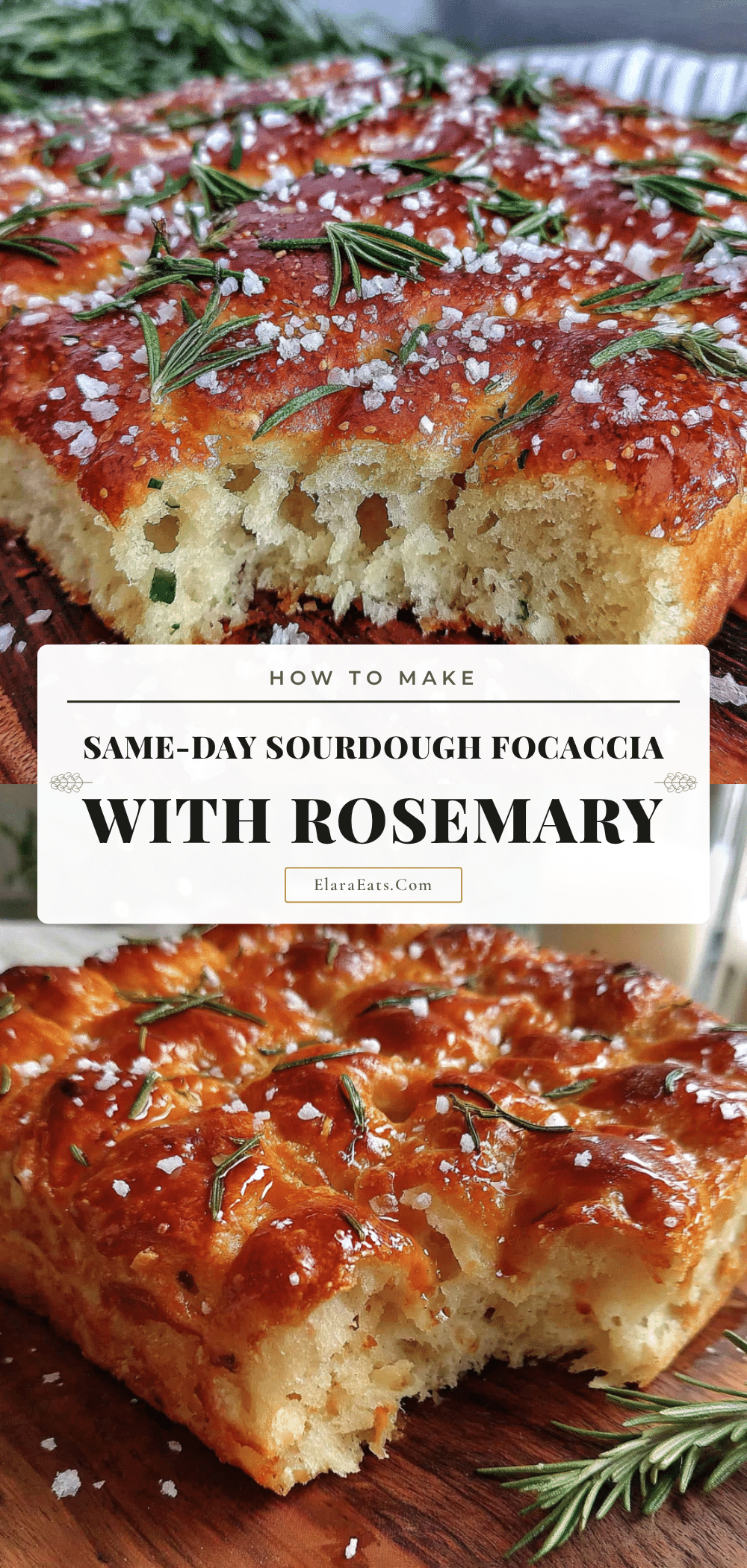
Best Easy Same-Day Sourdough Focaccia with Rosemary
This easy same-day sourdough focaccia with rosemary comes together in a single afternoon, delivering a crispy, golden crust and an airy, tender crumb. Perfect for any occasion, it uses simple ingredients and a forgiving technique that even beginners can master.
- Prep Time: 15 minutes
- Cook Time: 30 minutes
- Total Time: 5 hours 30 minutes
- Yield: 8 servings 1x
- Category: Bread
- Cuisine: Italian
Ingredients
- 500 grams (about 3 ¾ cups) bread flour
- 400 grams (about 1 ¾ cups) lukewarm water
- 150 grams (about ¾ cup) active sourdough starter, bubbly and fed within 4-6 hours
- 60 grams (about ¼ cup) extra-virgin olive oil, plus more for the pan and drizzling
- 10 grams (about 1 ½ teaspoons) fine sea salt
- 2 tablespoons fresh rosemary, finely chopped, plus more whole sprigs for topping
- Flaky sea salt (e.g., Maldon) for finishing
Instructions
- Mix the Dough (9:00 AM): In a large mixing bowl, combine 500 grams of bread flour and 10 grams of fine sea salt. Whisk together. In a separate measuring cup, mix 400 grams of lukewarm water and 150 grams of active sourdough starter. Stir until the starter is mostly dissolved. Pour the wet ingredients into the dry and mix until no dry bits remain. The dough will be shaggy and sticky. Cover with plastic wrap and let rest for 30 minutes (autolyse).
- Add the Olive Oil and Rosemary (9:30 AM): After the rest, drizzle 60 grams of olive oil over the dough and sprinkle in 2 tablespoons of chopped fresh rosemary. Using a wet hand, fold the dough over itself 6 to 8 times until the oil and rosemary are incorporated. Cover again.
- Bulk Fermentation with Coil Folds (9:30 AM to 2:00 PM): Over the next 4 to 5 hours, perform coil folds every 30 to 45 minutes during the first 2 hours. Wet your hand, reach under the dough, lift it up, and fold it under itself. Rotate the bowl 90 degrees and repeat 4 times per session. After 2 hours, let the dough rest, covered, for the remaining 2 to 3 hours until nearly doubled in size and bubbly.
- Prepare the Pan and Transfer the Dough (2:00 PM): Generously coat a 9×13-inch baking pan with olive oil. Gently scrape the dough into the pan. It won’t fill the pan. Let it rest, uncovered, for 20 minutes.
- Stretch and Dimple (2:20 PM): Oil your fingertips. Gently stretch the dough to the edges of the pan. If it resists, rest another 10 minutes. Once spread, dimple the entire surface with your fingertips, pressing all the way to the bottom. Drizzle with more olive oil and sprinkle with flaky sea salt and whole rosemary sprigs.
- Final Proof (2:20 PM to 3:20 PM): Cover the pan loosely with plastic wrap and let rise for 1 to 1.5 hours until puffy and filling the pan.
- Bake (3:20 PM to 3:50 PM): Preheat oven to 425°F (220°C) about 30 minutes before baking. Bake on the middle rack for 25 to 30 minutes until deep golden brown and crisp. If browning too fast, tent with foil for the last 5 minutes.
- Cool and Serve (3:50 PM): Let cool in the pan for 5 minutes, then transfer to a cooling rack. Cool for at least 20 minutes before slicing.
Notes
Use a good-quality extra-virgin olive oil for best flavor. If your kitchen is cold (below 70°F), use slightly warmer water (80-85°F) to help fermentation. The dough is ready for the pan when it jiggles like jelly. Don’t skip the coil folds—they build gluten structure. For a gluten-free version, substitute a 1:1 gluten-free flour blend and reduce water to 350 grams.
Nutrition
- Serving Size: 1/8 of recipe
- Calories: 280
- Sodium: 380
- Fat: 10
- Saturated Fat: 1.5
- Carbohydrates: 40
- Fiber: 2
- Protein: 7
Keywords: sourdough focaccia, easy focaccia, same-day focaccia, rosemary focaccia, sourdough bread, focaccia recipe