Love this? Save it for later!
Share the inspiration with your friends
I wasn’t trying to find a new fall cookie recipe. Honestly, I was at my neighbor’s house last October to borrow a ladder—my gutters were clogged, and it was pouring rain. But the second she opened the door, this smell hit me. It wasn’t pumpkin spice or cinnamon. It was warmer, fruitier, almost like walking into an apple orchard in the middle of a hug. She had a batch of these soft-baked apple cider cookies cooling on the counter, and she barely looked up from her mug of tea. “Oh, those? Just something I threw together,” she said, shrugging. Just something she threw together. Let me tell you, I almost forgot about the ladder entirely.
I stood there in her tiny kitchen, dripping on her floor, watching her casually slide a spatula under one of those pillowy cookies. The edges were barely golden, the tops were dusted with something sparkly, and they looked so impossibly soft I thought they might fall apart if I breathed too hard. She handed me one—warm, obviously—and told me to try it. That first bite was ridiculous. It was like biting into a cloud that tasted like caramelized apples and brown sugar, with this subtle tang that made me close my eyes without meaning to. I asked her for the recipe, and she just waved her hand and said, “Oh, it’s nothing, really.” But it wasn’t nothing. It was everything.
I’ve been making these cookies every single fall since that rainy afternoon. They’ve become my go-to for cozy nights when the wind is howling and I need something that feels like a warm blanket in food form. Maybe you’ve been there—craving a cookie that’s not crunchy, not crispy, but soft and tender and almost cake-like, with a flavor that reminds you of sipping hot cider by a fire. That’s exactly what these are. They’re not fancy. They’re not complicated. They’re just really, really good. And honestly, that’s the whole point.
Why You’ll Love This Recipe
These aren’t your average fall cookies. I’ve tested this recipe at least a dozen times—tweaking the flour ratio, playing with the apple cider reduction, even trying different types of apples—and what I’ve landed on is genuinely the best version. Here’s why you’ll want to make them immediately:
- Quick & Easy: From start to finish, these cookies come together in about 30 minutes. No chilling the dough, no complicated steps. Just mix, scoop, and bake.
- Simple Ingredients: You probably already have most of what you need in your pantry. The only special item is apple cider, and that’s easy to find in the fall.
- Perfect for Cozy Evenings: These cookies were born on a rainy day, and they’re made for exactly that kind of mood. Cold weather, a good book, a hot drink—these cookies complete the picture.
- Crowd-Pleaser: I’ve brought these to potlucks and family gatherings, and they disappear faster than anything else on the table. Kids love them. Adults love them. Even my friend who “doesn’t really like sweets” ate three.
- Unbelievably Delicious: The texture is what gets everyone. They’re soft without being doughy, tender without being fragile, and the apple cider flavor is concentrated and real—not artificial or faint.
What makes this recipe different from all the other apple cider cookie recipes out there? It’s the reduction. Most recipes just dump in apple cider and hope for the best. But I simmer mine down until it’s thick and syrupy, concentrating all that fruity, tangy sweetness into something that actually tastes like real apples. It’s a small extra step, but it makes all the difference. Plus, the combination of brown sugar and a touch of cinnamon creates this deep, almost caramel-like flavor that pairs perfectly with the cider. This isn’t just another fall cookie—it’s the fall cookie.
What Ingredients You Will Need
This recipe uses simple, wholesome ingredients to deliver that soft, pillowy texture and bold apple flavor. Nothing weird, nothing hard to find—just good, honest baking staples that work together beautifully.
For the Cookies
- Apple cider, 1 cup (240 ml) – You’ll reduce this on the stove to concentrate the flavor. Use fresh, unfiltered cider if you can find it; it has more apple flavor than the filtered stuff.
- Unsalted butter, ½ cup (113 g), softened – Make sure it’s at room temperature so it creams properly with the sugar. I like using Kerrygold for the richer flavor, but any good unsalted butter works.
- Light brown sugar, ¾ cup (150 g), packed – This gives the cookies their deep, molasses-like sweetness and helps keep them soft. Don’t substitute granulated sugar here—you need the moisture from the brown sugar.
- Granulated sugar, ¼ cup (50 g) – A little bit of white sugar balances the brown sugar and helps with browning.
- Large egg, 1, at room temperature – Room temperature eggs incorporate more evenly into the batter. If you forgot to take yours out, just place it in a bowl of warm water for 5 minutes.
- Vanilla extract, 1 teaspoon – Pure vanilla extract adds warmth and depth. Imitation vanilla works in a pinch, but the real stuff is better here.
- All-purpose flour, 2 cups (250 g) – Spoon and level your flour—don’t scoop directly from the bag, or you’ll end up with dry cookies.
- Baking soda, 1 teaspoon – This helps the cookies spread just enough and gives them that soft, tender crumb.
- Baking powder, ½ teaspoon – Adds a little extra lift for a cake-like texture.
- Ground cinnamon, 1 teaspoon – The classic apple spice. It’s subtle but essential.
- Salt, ½ teaspoon – Don’t skip this! Salt balances the sweetness and makes the apple flavor pop.
For the Cinnamon Sugar Coating
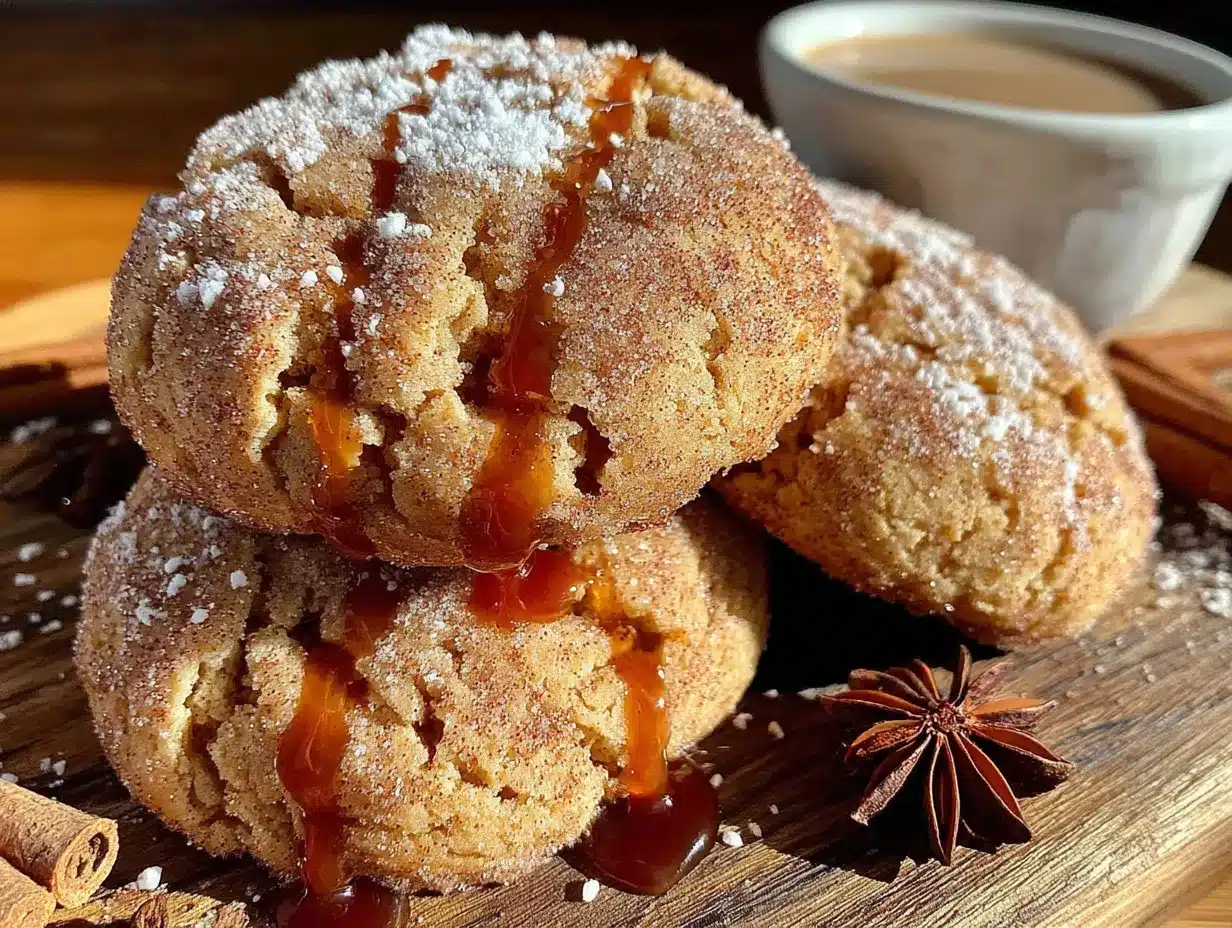
- Granulated sugar, ¼ cup (50 g)
- Ground cinnamon, 1 tablespoon
A quick note on substitutions: If you need a dairy-free option, you can use vegan butter in place of regular butter—just make sure it’s softened. For a gluten-free version, swap the all-purpose flour with a good 1-to-1 gluten-free baking flour blend. I’ve tried this with Bob’s Red Mill and it worked beautifully. And if you don’t have apple cider, you can use apple juice in a pinch, but the flavor won’t be as concentrated. Trust me, the reduction step is worth the extra 10 minutes.
Equipment Needed
You don’t need a fancy kitchen to make these cookies. Here’s what you’ll need:
- Medium saucepan – For reducing the apple cider. A small saucepan works too, but a medium one gives the cider more surface area to evaporate faster.
- Large mixing bowl – For creaming the butter and sugar. I use a glass bowl, but any bowl will do.
- Electric hand mixer or stand mixer – You can cream butter and sugar by hand, but a mixer makes it much easier and gives you a fluffier result. I’ve done both, and the mixer is definitely worth the effort.
- Whisk – For mixing the dry ingredients together.
- Rubber spatula – For folding in the dry ingredients and scraping down the sides of the bowl.
- Cookie scoop or tablespoon – For portioning the dough evenly. A 1.5-tablespoon scoop is perfect for this recipe.
- Baking sheet – I recommend a light-colored, rimmed baking sheet for even browning. Dark sheets can cause the bottoms to brown too quickly.
- Parchment paper or silicone baking mat – This prevents sticking and makes cleanup so much easier.
- Cooling rack – For cooling the cookies completely. If you don’t have one, you can just let them cool on the baking sheet for a few extra minutes, then transfer to a plate.
If you don’t have a cookie scoop, don’t worry. Just use a tablespoon and roll the dough into balls with your hands. It’s a little messier, but the cookies will turn out just as good. And if you’re using a dark baking sheet, lower your oven temperature by 25°F to prevent over-browning.
Preparation Method
Alright, let’s get to the good part. Here’s how to make these cozy soft-baked apple cider cookies step by step.
- Reduce the apple cider. Pour the 1 cup of apple cider into a medium saucepan and bring it to a boil over medium-high heat. Once it’s boiling, reduce the heat to medium-low and let it simmer, stirring occasionally, until it’s reduced to about ¼ cup. This takes about 10–12 minutes. You’ll know it’s ready when it’s thick and syrupy, and it coats the back of a spoon. Set it aside to cool while you prepare the rest of the ingredients. Don’t skip this step—it’s what gives the cookies their intense apple flavor.
- Preheat the oven. Set your oven to 350°F (175°C). Line two baking sheets with parchment paper or silicone baking mats.
- Cream the butter and sugars. In a large mixing bowl, beat the softened butter, brown sugar, and granulated sugar together with an electric mixer on medium speed until light and fluffy—about 2–3 minutes. Scrape down the sides of the bowl with a rubber spatula halfway through. The mixture should look pale and slightly airy. If it looks greasy or separated, you’ve overmixed it. Just keep going and it’ll come together.
- Add the egg, vanilla, and reduced cider. Beat in the egg, vanilla extract, and the cooled reduced apple cider until everything is well combined. The batter might look a little curdled at this point—don’t panic. That’s normal, and it will smooth out once you add the dry ingredients. Scrape down the bowl again to make sure everything is incorporated.
- Mix the dry ingredients. In a separate bowl, whisk together the flour, baking soda, baking powder, cinnamon, and salt. This ensures the leavening agents and spices are evenly distributed throughout the flour.
- Combine the wet and dry ingredients. Gradually add the dry ingredients to the wet mixture, mixing on low speed or folding with a spatula until just combined. Be careful not to overmix—stop as soon as you no longer see streaks of flour. Overmixing will make the cookies tough instead of tender.
- Prepare the cinnamon sugar coating. In a small bowl, whisk together the ¼ cup granulated sugar and 1 tablespoon cinnamon.
- Scoop and coat the dough. Using a 1.5-tablespoon cookie scoop or a tablespoon, portion out the dough and roll each portion into a ball. Roll each ball in the cinnamon sugar mixture until completely coated, then place them on the prepared baking sheets, spacing them about 2 inches apart. You should get about 18–20 cookies.
- Bake. Bake for 10–12 minutes, or until the edges are set and the tops look just barely golden. The centers will look slightly underdone—that’s what you want. They’ll continue to set as they cool on the baking sheet. If you overbake them, they’ll lose their soft, pillowy texture.
- Cool. Let the cookies cool on the baking sheet for 5 minutes, then transfer them to a cooling rack to cool completely. If you try to move them too soon, they’ll fall apart. Be patient—I learned this the hard way.
A few things to watch for: If your dough feels too sticky to roll into balls, pop it in the fridge for 15 minutes to firm up. If it feels too dry, add a tablespoon of milk or apple cider. And if your cookies spread too much in the oven, your butter was probably too soft or your baking soda is old. Check the expiration date on your baking soda—it loses its potency over time.
Cooking Tips & Techniques
I’ve made these cookies more times than I can count, and I’ve definitely had my share of failures. Here are the lessons I learned the hard way, so you don’t have to.
Don’t rush the cider reduction. The first time I made these, I tried to speed up the reduction by cranking up the heat. Bad idea. The cider burned and turned bitter, and the cookies tasted like someone had dropped a match into the batter. Keep the heat medium-low and stir occasionally. You’re looking for a syrupy consistency—not caramel, but definitely thicker than maple syrup. It should coat the back of a spoon and leave a clear trail when you run your finger through it.
Measure your flour correctly. This is probably the most common mistake in cookie baking. If you scoop your measuring cup directly into the flour bag, you’ll end up with more flour than the recipe calls for, which leads to dry, crumbly cookies. Instead, use a spoon to fluff the flour in the bag, then spoon it into your measuring cup and level it off with a knife. It takes an extra 10 seconds and makes a huge difference.
Room temperature ingredients matter. I know, I know—every recipe says this, and it’s tempting to use cold butter straight from the fridge. But cold butter doesn’t cream properly with sugar, which means your cookies won’t have that light, tender texture. If you forgot to soften your butter, cut it into small cubes and microwave it in 5-second bursts until it’s soft but not melted. Same goes for the egg—place it in a bowl of warm water for 5 minutes to bring it to room temperature.
Multitasking is your friend. While the apple cider is reducing, you can measure out your dry ingredients and line your baking sheets. While the cookies are baking, you can wash the dishes. This recipe moves fast once you start mixing, so having everything prepped ahead of time makes the process much smoother. I like to set out all my ingredients before I even turn on the stove.
Test your baking soda. If your cookies don’t spread at all or come out dense and flat, your baking soda might be expired. To test it, drop a teaspoon of baking soda into a small bowl of vinegar. If it fizzes vigorously, it’s still good. If it barely bubbles, toss it and buy a new box. It’s a cheap ingredient, and fresh baking soda makes a huge difference in the texture of your cookies.
Variations & Adaptations
One of the best things about this recipe is how easy it is to adapt. Here are some of my favorite variations:
Apple Cider Cookies with Caramel Drizzle. After the cookies have cooled completely, drizzle them with a simple caramel sauce. You can use store-bought or make your own by melting 10 caramel candies with 1 tablespoon of heavy cream in the microwave. It takes the cookies from cozy to decadent in about 30 seconds.
Vegan Apple Cider Cookies. Swap the butter for vegan butter, replace the egg with a flax egg (1 tablespoon ground flaxseed mixed with 3 tablespoons water, let sit for 5 minutes), and use a plant-based milk if the dough needs moisture. They won’t be quite as tender as the original, but they’re still delicious. I tested this version for a friend’s birthday party, and no one even noticed the difference.
Apple Cider Cookies with Walnuts or Pecans. Fold in ½ cup of chopped walnuts or pecans along with the dry ingredients. The crunch adds a nice contrast to the soft cookie texture. Toast the nuts in a dry skillet for 3–4 minutes first to bring out their flavor—it’s a small step that makes a big difference.
Gluten-Free Apple Cider Cookies. Use a 1-to-1 gluten-free baking flour blend. I’ve tried this with both Bob’s Red Mill and King Arthur Measure for Measure, and both worked well. The cookies will be slightly more delicate, so handle them gently when transferring to the cooling rack.
Spiced Apple Cider Cookies. Add ¼ teaspoon of ground nutmeg, ¼ teaspoon of ground ginger, and a pinch of ground cloves to the dry ingredients. This creates a chai-like spice blend that pairs beautifully with the apple cider. I made this version for a holiday cookie exchange, and it was the first tray to empty.
If you want to make these into apple cider cookie sandwiches, just bake the cookies slightly smaller and fill them with cream cheese frosting or vanilla buttercream. It’s a fun twist for special occasions.
Serving & Storage Suggestions
These cookies are best served warm, straight from the oven, when they’re at their softest and most fragrant. But let’s be real—they’re pretty amazing at room temperature too. I like to serve them with a hot mug of spiced chai, a cup of coffee, or a glass of cold milk. If you’re feeling fancy, arrange them on a wooden board with sliced apples, a wedge of sharp cheddar cheese, and a handful of candied pecans. It makes for a beautiful fall dessert board that’s perfect for entertaining.
For storage, place the cooled cookies in an airtight container at room temperature. They’ll stay soft for up to 4 days. To keep them even softer, add a slice of bread to the container—the bread absorbs excess air and releases moisture, keeping the cookies tender. Replace the bread slice every day or two if you’re storing them for longer.
These cookies also freeze beautifully. To freeze, arrange the baked and cooled cookies in a single layer on a baking sheet and freeze for 1 hour. Then transfer them to a freezer-safe bag or container, with parchment paper between layers to prevent sticking. They’ll keep for up to 3 months. When you’re ready to eat them, let them thaw at room temperature for about 15 minutes, or pop them in a 300°F oven for 5 minutes to warm them up.
The flavors actually develop over time. I’ve found that day-old cookies taste even more apple-forward than fresh ones, probably because the cider flavor has had time to meld with the other ingredients. So don’t worry if you can’t finish the batch in one sitting—they’ll still be delicious tomorrow.
Nutritional Information & Benefits
Here’s the estimated nutritional breakdown for one cookie (based on a batch of 18 cookies):
- Calories: 165
- Total Fat: 7g
- Saturated Fat: 4g
- Cholesterol: 30mg
- Sodium: 95mg
- Total Carbohydrates: 25g
- Dietary Fiber: 0.5g
- Sugars: 15g
- Protein: 2g
These cookies are a treat, so I’m not going to pretend they’re health food. But they do have a few redeeming qualities. The apple cider provides a small amount of vitamin C and antioxidants, and the cinnamon has anti-inflammatory properties. Plus, using brown sugar instead of all white sugar gives you a tiny bit more minerals like calcium and potassium. If you’re looking to cut down on sugar, you can reduce the brown sugar to ½ cup and add an extra tablespoon of reduced cider for sweetness. I’ve tried it, and the cookies are still plenty satisfying.
For those with dietary restrictions, this recipe contains gluten and dairy. For gluten-free and vegan options, check the variations section above. These cookies are not suitable for anyone with nut allergies unless you skip the optional nuts.
Conclusion
These cozy soft-baked apple cider cookies are everything I want in a fall dessert—warm, comforting, and full of real apple flavor. They’re the kind of cookie that makes you want to curl up on the couch with a blanket and a good book, and honestly, that’s exactly what I do every time I make them. The recipe is simple enough for a weekday baking session but impressive enough to bring to a holiday party. And that texture? Soft, pillowy, almost cake-like—it’s the texture that keeps people coming back for more.
I’d love to hear how these turn out for you. Did you add any variations? Did you serve them with something special? Drop a comment below and let me know. And if you share a photo on Pinterest or Instagram, tag me—I love seeing your creations. Trust me, once you make these, they’ll become a staple in your fall baking rotation. They certainly have in mine.
Frequently Asked Questions
Can I use apple juice instead of apple cider?
You can, but the flavor won’t be as strong or complex. Apple cider is unfiltered and has a more robust, tangy flavor than apple juice. If you use apple juice, the cookies will be sweeter and less apple-forward. I’d recommend adding an extra ¼ teaspoon of cinnamon to compensate.
Why did my cookies come out flat?
Flat cookies usually mean your butter was too soft or melted, or your baking soda is expired. Make sure your butter is softened but not melted, and test your baking soda before using it. Also, if you skip the chilling step (if your dough is too sticky), the cookies can spread too much in the oven.
Can I make the dough ahead of time?
Absolutely. You can prepare the dough, roll it into balls, coat them in the cinnamon sugar, and refrigerate them on a baking sheet for up to 24 hours. When you’re ready to bake, just add an extra minute or two to the baking time since the dough will be cold. You can also freeze the dough balls for up to 3 months—just bake from frozen, adding 2–3 minutes to the baking time.
How do I know when the cookies are done baking?
The edges should be set and just barely golden, while the centers still look slightly underdone and puffy. They’ll continue to set as they cool on the baking sheet. If you wait until the centers look fully baked, the cookies will be overbaked and lose their soft texture. Trust the visual cues, not the clock.
Can I double this recipe?
Yes, this recipe doubles beautifully. Just make sure you have enough baking sheets to bake the cookies in batches, and don’t overcrowd the oven. If you’re baking multiple trays at once, rotate them halfway through the baking time for even browning. The reduced cider will take a little longer to reduce if you double it, so plan for about 15–18 minutes of simmering instead of 10–12.
Pin This Recipe!
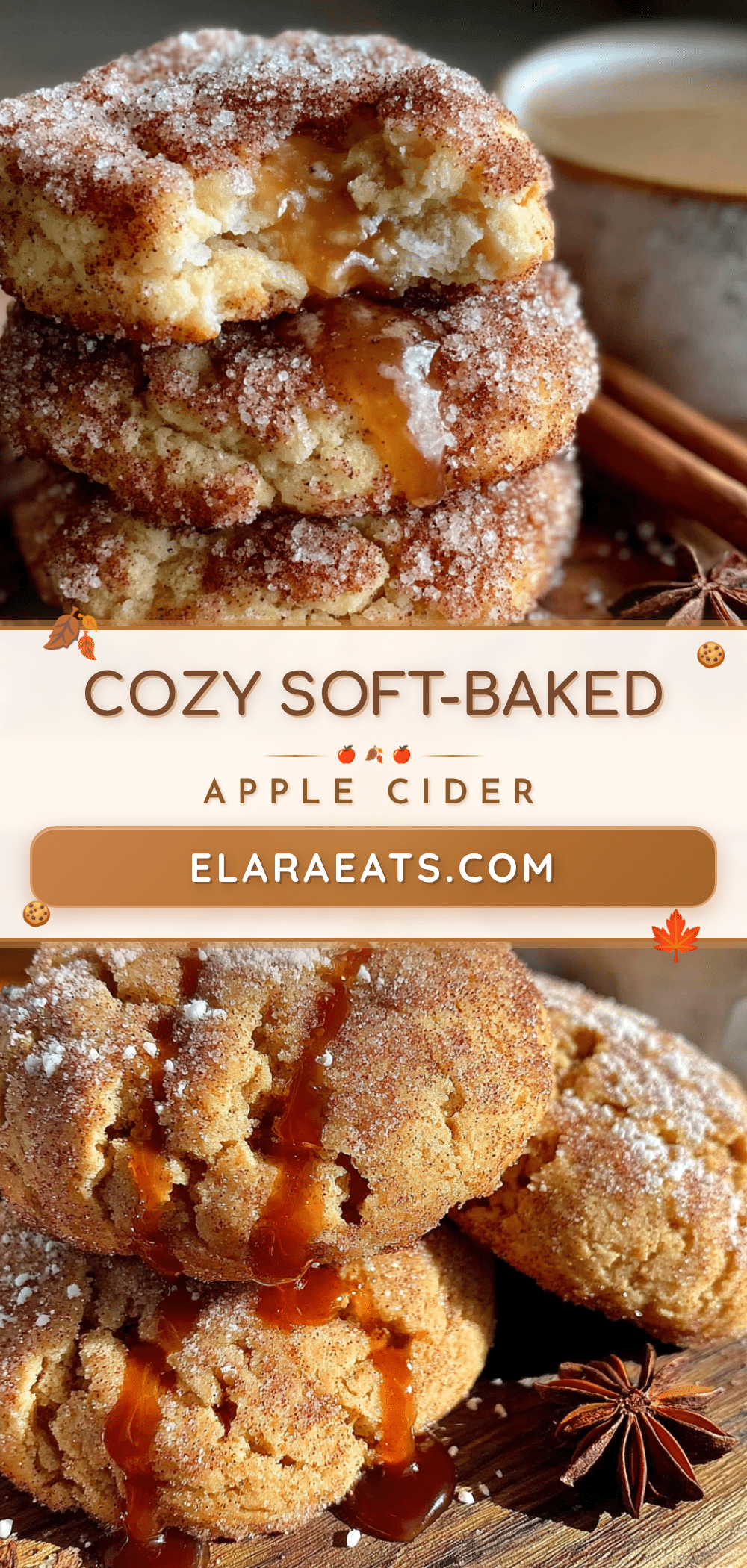
Cozy Soft-Baked Apple Cider Cookies: Easy Fall Recipe

These soft-baked apple cider cookies are pillowy, tender, and full of concentrated apple flavor. Made with reduced apple cider and a cinnamon sugar coating, they’re the perfect cozy fall treat.
- Prep Time: 15 minutes
- Cook Time: 12 minutes
- Total Time: 30 minutes
- Yield: 18-20 cookies 1x
- Category: Dessert
- Cuisine: American
Ingredients
- 1 cup (240 ml) apple cider
- ½ cup (113 g) unsalted butter, softened
- ¾ cup (150 g) light brown sugar, packed
- ¼ cup (50 g) granulated sugar
- 1 large egg, at room temperature
- 1 teaspoon vanilla extract
- 2 cups (250 g) all-purpose flour
- 1 teaspoon baking soda
- ½ teaspoon baking powder
- 1 teaspoon ground cinnamon
- ½ teaspoon salt
- ¼ cup (50 g) granulated sugar (for coating)
- 1 tablespoon ground cinnamon (for coating)
Instructions
- Reduce the apple cider: Pour 1 cup apple cider into a medium saucepan and bring to a boil over medium-high heat. Reduce heat to medium-low and simmer, stirring occasionally, until reduced to about ¼ cup (10–12 minutes). Set aside to cool.
- Preheat oven to 350°F (175°C). Line two baking sheets with parchment paper or silicone baking mats.
- In a large mixing bowl, beat softened butter, brown sugar, and granulated sugar with an electric mixer on medium speed until light and fluffy (2–3 minutes). Scrape down the bowl halfway through.
- Beat in the egg, vanilla extract, and cooled reduced apple cider until well combined. The batter may look curdled; this is normal.
- In a separate bowl, whisk together flour, baking soda, baking powder, cinnamon, and salt.
- Gradually add dry ingredients to wet mixture, mixing on low speed or folding with a spatula until just combined. Do not overmix.
- In a small bowl, whisk together ¼ cup granulated sugar and 1 tablespoon cinnamon for the coating.
- Using a 1.5-tablespoon cookie scoop or tablespoon, portion dough into balls. Roll each ball in the cinnamon sugar mixture until completely coated. Place on prepared baking sheets, spacing 2 inches apart (about 18–20 cookies).
- Bake for 10–12 minutes, until edges are set and tops are just barely golden. Centers will look slightly underdone.
- Let cookies cool on baking sheet for 5 minutes, then transfer to a cooling rack to cool completely.
Notes
Don’t rush the cider reduction; keep heat medium-low to avoid burning. Measure flour correctly by spooning and leveling. Room temperature ingredients are key for best texture. If dough is too sticky, refrigerate for 15 minutes. Cookies stay soft for up to 4 days in an airtight container; add a slice of bread to keep them softer. Freeze baked cookies for up to 3 months.
Nutrition
- Serving Size: 1 cookie
- Calories: 165
- Sugar: 15
- Sodium: 95
- Fat: 7
- Saturated Fat: 4
- Carbohydrates: 25
- Fiber: 0.5
- Protein: 2
Keywords: apple cider cookies, soft baked cookies, fall cookies, apple cookies, cinnamon sugar cookies, easy cookie recipe